

NGO Funding: AI Is Reshaping the Rules of a System Under Heavy Pressure
In a global context where competition for funding is becoming increasingly intense, civil society organisations are facing a paradox: needs are rising while access to resources is becoming more complex. Artificial intelligence (AI) is gradually emerging as a transformative lever for the sector, capable of drastically reducing the time required to prepare funding applications and reshaping the relationship between NGOs and donors. By the editorial team


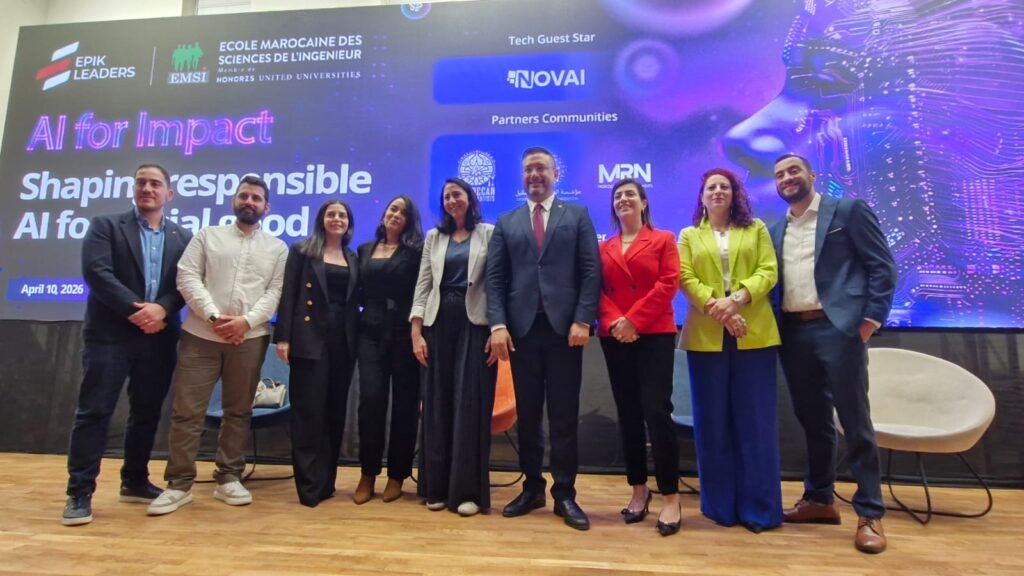
It is one of the key takeaways from the AI FOR IMPACT conference held on April 10 in Casablanca, on the sidelines of GITEX Africa, organised by EPIK Leaders and the Moroccan School of Engineering Sciences (EMSI), a member of Honoris United Universities, which brought together technology experts and civil society actors to discuss the evolving landscape of social impact funding.
A Saturated and Time-Consuming Funding System
The observation is shared by all stakeholders: accessing funding has become a heavy and uncertain process. On average, an NGO spends between 30 and 50 hours drafting a single funding application. In some cases, donor guidelines exceed 340 pages, illustrating the increasing complexity of administrative requirements.
Today, the main barrier for NGOs is no longer the lack of funding, but access to it
In addition, there is growing international competition for limited resources, forcing organisations to invest more time in fundraising than in implementing their projects.
AI as a Structural Break in Access to Funding
In this context, AI introduces a major shift. It significantly reduces the time required to prepare applications, going from dozens of hours to just a few minutes according to demonstrations presented during the conference.
For experts gathered in Casablanca, the real challenge is no longer the existence of funding, but its accessibility.
“Today, the main barrier for NGOs is no longer the lack of funding, but access to it. AI is reshaping the landscape: those who adopt it will gain a decisive advantage,” explained Dr Nizar Chaari, founder of EPIK Leaders.
NOVAI, an Example of Intelligent Funding Automation
The NOVAI platform, presented during the event, illustrates this transformation in concrete terms. It combines several features: a continuously updated funding database, an intelligent matching system assessing NGO eligibility, an AI assistant to generate and customise proposals, and final validation by human experts.
“No impactful idea should remain unfunded due to limited access to information or expertise,” stressed the founder of NOVAI, highlighting the technology’s inclusive ambition.
A Transformation That Also Questions Existing Models
Beyond efficiency gains, speakers emphasised the need to design responsible and inclusive AI systems.
Three key points emerged from the discussions: first, AI enhances human expertise but does not replace it; second, structural constraints faced by African NGOs (connectivity, data availability, linguistic diversity) must be integrated from the design stage of tools; finally, gender equality must be a foundational principle, not a post-design correction.
No impactful idea should remain unfunded due to limited access to information or expertise
According to Fatima-Zahra Bounaffaa, founder of Parcours MCE, “artificial intelligence amplifies the intention of the user. It saves time on repetitive tasks and allows that time to be reinvested in impact.”
Morocco, an African Laboratory for AI Applications
Organised on the sidelines of GITEX Africa, the conference also confirms Morocco’s positioning as a continental technology hub for applied artificial intelligence in development contexts.
The initiative is part of the EPIK Leaders dynamic, a pan-African network launched in 2025, which today brings together more than 50,000 members and 550 clubs across 15 African countries. This growth reflects increasing interest in hybrid models combining technology, social impact, and institutional structuring.
The next announced milestone is Africa Future Leaders Day in Dakhla, focused on African soft power issues.