


Air travel fuel: soaring costs force airlines to cut flights and networks
Since the escalation of the conflict in the Middle East, jet fuel prices have sharply increased, rising from around 750 dollars per ton to nearly 2,000 dollars in early April, more than double the 2025 average, according to aviation fuel market data tracked by the International Air Transport Association (IATA). This surge is already reshaping airline strategies through higher fares, reduced frequencies and flight cancellations. By the editorial team

The sharp rise in aviation fuel prices comes amid a tense geopolitical context, marked by the economic repercussions of the Middle East conflict on global energy markets. Jet fuel, which represents on average between 20% and 30% of airline operating costs according to the International Air Transport Association, is one of the most sensitive factors affecting sector profitability.
Jet fuel prices have almost tripled in early April
Since the onset of tensions, jet fuel prices have almost tripled at certain supply hubs, rising from around 750 dollars to nearly 2,000 dollars in early April according to market benchmarks monitored by the Energy Information Administration and jet fuel indices published by the IATA. This volatility far exceeds the average levels observed in 2025 and highlights the aviation sector’s deep exposure to geopolitical and energy cycles.
In response to this pressure, airlines have three main levers: raising fares, reducing capacity or optimizing their networks
In response to this pressure, airlines have three main levers: raising fares, reducing capacity or optimizing their networks. In practice, these adjustments are often combined. Higher ticket prices become unavoidable on certain routes, while secondary destinations are the first to be affected by capacity cuts.
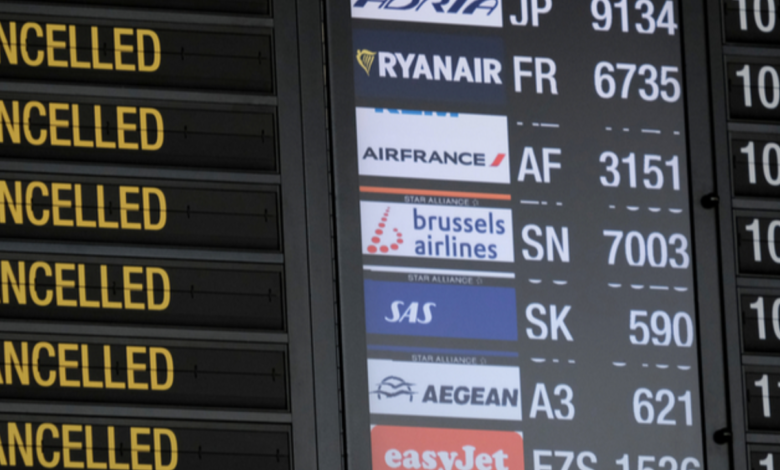
In Europe, several carriers have already announced adjustments. KLM confirmed the cancellation of around 160 European flights over a recent period due to rising operating costs. Lufthansa is pursuing a fleet rationalization strategy by gradually grounding less fuel-efficient aircraft. Other low-cost carriers such as Ryanair have warned of a potential 5% to 10% reduction in their flight schedules during certain periods if the trend persists. SAS and Volotea have also adjusted their networks, particularly on regional routes.
In the United States, the response is similar, with a stronger concentration of flights on major hubs. United Airlines announced a capacity reduction of around 5% as early as March, while Delta Air Lines has removed several unprofitable domestic rotations. Airlines are now prioritizing high-density routes to absorb rising costs.
In Asia, Cathay Pacific has reduced its flight programme by around 5% to 6%, while several Chinese airlines are restructuring their networks around international hubs to maximize profitability. In India, carriers have so far opted for significant fare increases rather than large-scale reductions in frequency, but this strategy may reach its limits if fuel prices remain elevated.
In Africa, the situation is even more complex: aviation fuel costs are structurally higher
In Africa, the situation is even more complex. According to the African Airlines Association (AFRAA), aviation fuel costs are structurally higher than in other regions due to logistics costs and import dependence. Several airlines have already reduced domestic flights, with some warning of possible suspension of unprofitable routes if pressure continues.
In the Gulf countries, directly exposed to regional tensions, disruptions are also significant. Some airlines have adjusted a substantial share of their flight programmes due to a combination of security risks and rising jet fuel costs purchased at market prices.
According to the International Air Transport Association, every 10-dollar increase in the price of oil results in a significant rise in global airline operating costs, illustrating the industry’s extreme sensitivity to energy shocks.