

Opinion |Nature’s Quiet Return: Why Restoration is Africa’s Most Effective Climate Strategy
Across Africa’s coastlines, forests, and drylands, nature is quietly rebuilding what human systems have broken. From the ongoing restoration process of mangroves in Benin to protecting forests initiatives in Gabon, a sustainable solution is in plain sight. Dr Venter Mwongera, CEO of the African Biodiversity Alliance, argues that nature-based solutions are no longer optional but central to climate survival. She makes the case that restoring ecosystems is not just environmental action; it is an economic, social, and existential transformation.

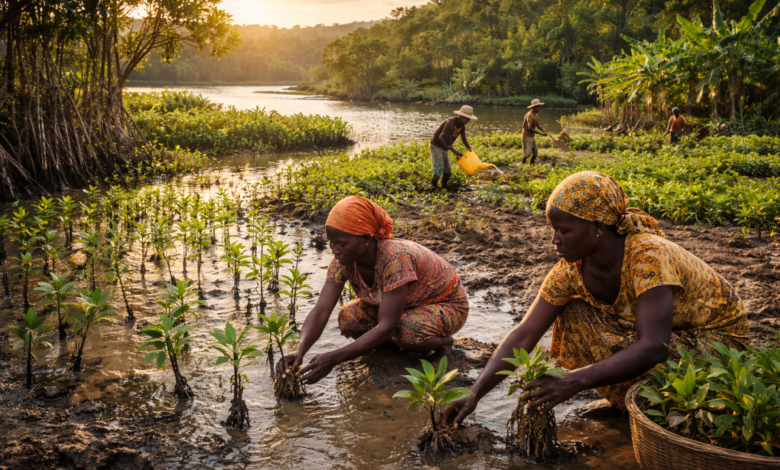
At dawn in southern Benin, I recently walked with a fisherman along a stretch of coast where mangroves had long been stripped away for fuelwood. He pointed to the waterline and told me, almost apologetically, how the fish had disappeared over the years. Then he gestured toward a newly restored patch of mangroves; young, still fragile, but alive. “They are coming back,” he said. “Slowly, but they are coming back.” That quiet return of fish, of roots, of hope is the story of nature-based solutions across Africa today. For too long, climate action has been framed as a technological race: solar panels, carbon capture, electric grids. These are essential. But beneath this narrative lies a more traditional, critical truth: nature itself is one of our most effective climate allies. The growing global momentum around Nature-Based Solutions (NbS) and ecosystem restoration signals a profound shift: from engineering our way out of crisis to partnering with living systems that have sustained the planet for millennia. Nowhere is this shift more urgent or more promising than in Africa.
The Power of Letting Nature Heal
Nature-based solutions are, at their core, deceptively simple. Restore what has been degraded. Protect what remains. Manage ecosystems in ways that benefit both people and the planet. But their impact is anything but simple. The United Nations Environment Programme has highlighted that restoring ecosystems such as forests, wetlands, and coastal zones can simultaneously sequester carbon, protect biodiversity, and strengthen community resilience. Meanwhile, leading ocean research initiatives estimate that marine and coastal ecosystems alone could deliver up to 35% of the emissions reductions needed by 2050 to meet global climate targets. This is not a marginal contribution. It is central to our survival. Yet the real story of NbS is not found in global statistics. It is found in places like Benin, Cameroon, Gabon, and Egypt, among other countries in Africa, where restoration is not an abstract concept, but a lived experience.
Benin: Where Mangroves Rebuild Livelihoods
In Benin, mangrove restoration has become both an ecological and economic lifeline. Communities that once depended on cutting mangroves for survival are now leading efforts to restore them. The transformation is striking. Mangroves, often overlooked, are among the most reliable carbon sinks on Earth, storing up to 4 times more carbon per hectare than terrestrial forests. But for local communities, their value is even more immediate. They serve as nurseries for fish, buffers against coastal erosion, and natural defenses against storm surges. As the mangroves return, so too do the fish stocks. Women who once walked miles for firewood are now engaged in sustainable harvesting practices. Youth groups are being trained as restoration stewards. What we see here is not just ecosystem recovery; it is the rebuilding of local economies rooted in nature.
Cameroon: Forests as Climate Infrastructure
I travel inland to Cameroon, and the story shifts from coastlines to dense tropical forests. The Congo Basin, which extends into Cameroon, is the second-largest rainforest in the world. Often referred to as the “lungs of Africa,” it plays a critical role in regulating regional and global climate systems. But these forests are under pressure from logging, agriculture, and infrastructure expansion. In response, most communities in Cameroon are increasingly embracing landscape restoration approaches that balance conservation with livelihoods. Agroforestry systems, where crops are grown alongside trees, are gaining traction. Farmers are integrating cocoa production with native tree species, enhancing both biodiversity and income stability. This is NbS at its most sophisticated: not preserving forests in isolation, but embedding them within productive landscapes. Research from global institutions such as the Food and Agriculture Organization underscores that such integrated systems can increase resilience to climate shocks while maintaining or even improving yields. They also reduce the need for further deforestation, creating a virtuous cycle of restoration and productivity. In Cameroon, forests are no longer seen as barriers to development. They are being reimagined as essential infrastructure for climate resilience.
Gabon: A Nation Built on Conservation
Few countries embody the promise of NbS as importantly as most communities in Gabon. With over 80% of its land covered by forest, Gabon has positioned itself as a global leader in conservation-driven development. It has demonstrated that protecting ecosystems is not incompatible with economic growth. In fact, it can be the foundation of it. Gabon’s forests absorb vast amounts of carbon, making the country one of the few in the world with a net carbon sink economy. Through innovative policies, including results-based payments for forest conservation, Gabon has shown that ecosystems can generate financial value without being destroyed. But perhaps the most important lesson from Gabon is philosophical. It challenges the deeply entrenched notion that development must come at the expense of nature. Instead, it offers a different model, one where nature is not exploited for growth, but safeguarded as its source.
Egypt: Restoring Life in Arid Landscapes
At first glance, Egypt may seem an unlikely candidate for nature-based solutions. Its arid landscapes and water scarcity present formidable challenges. Yet it is precisely in such environments that NbS reveal their transformative potential. In Egypt, restoration efforts are increasingly focused on sustainable land and water management, reviving degraded lands, improving soil health, and optimizing irrigation systems. Coastal ecosystems along the Mediterranean, including wetlands and lagoons, are being recognized for their role in protecting against sea-level rise and supporting fisheries. Regenerative agriculture practices are also gaining attention, where communities, though miniature, are reducing chemical inputs, enhancing soil organic matter, and improving water retention. These interventions may appear modest compared to large-scale infrastructure projects. But their cumulative impact is profound. In a region where climate change is expected to intensify water scarcity, NbS offers a pathway to adaptation rooted in ecological intelligence rather than technological dependency alone.
Beyond Restoration: A Shift in Mindset
What unites these diverse experiences from Benin’s mangroves to Gabon’s forests is a deeper transformation in how we think about nature. Nature-based solutions are not just technical interventions. They represent a shift in worldview. For decades, development has been driven by extraction, removing value from ecosystems until they collapse. NbS invites us to reverse this logic: to invest in ecosystems so they can continue generating value indefinitely. This is why NbS are attracting unprecedented policy attention and funding globally. Governments, development banks, and private investors are increasingly recognizing that restoration is not a cost; it is an investment with multiple returns: climate mitigation, biodiversity recovery, food security, and economic resilience.
The Risk of Oversimplification
Yet we must also be cautious. The growing popularity of NbS carries risks. There is a danger that it becomes a buzzword deployed in policy documents without meaningful implementation. Poorly designed projects can displace communities, oversimplify complex ecosystems, or prioritize carbon metrics over biodiversity and social outcomes. True nature-based solutions must be:
- Locally led.
- Scientifically grounded.
- Socially inclusive.
They must respect the knowledge of communities who have managed these ecosystems for generations.
A Continent of Possibility
Africa stands at a pivotal moment. With vast natural assets, from forests and wetlands to drylands and coastlines, the continent holds immense potential to lead the world in NbS. But this potential will only be realized if restoration is embedded within broader development strategies. This means aligning policies across sectors:
- Agriculture.
- Environment.
- Finance.
- Infrastructure.
It means investing in community-led restoration efforts. It means redefining success not just in terms of GDP growth, but in terms of ecosystem health and human well-being.
Returning to the Mangroves
I often think back to that fisherman in Benin. His story is not just about mangroves. It is about patience. About trust in processes that take time. About the quiet, often invisible work of regeneration. Nature does not respond to urgency in the way politics does. It operates on longer timelines, deeper rhythms. But when we give it space to recover, it does something extraordinary. It comes back. And in coming back, it brings us with it, toward a future that is not only more sustainable, but more just, more resilient, and more alive. The question before us is not whether nature-based solutions work. It is whether we are willing to invest, at scale and with sincerity, in the only system that has ever truly sustained us.