


UN : a $400 million appeal amid a crisis of international law
Weakened by an acute financial crisis and confronted with a multiplication of violations of international law — from Gaza to Venezuela — the United Nations is warning of a historic risk of erosion of the global human rights protection system. The Office of the High Commissioner is appealing for $400 million in contributions for 2026 to avert a major setback. Analysis.

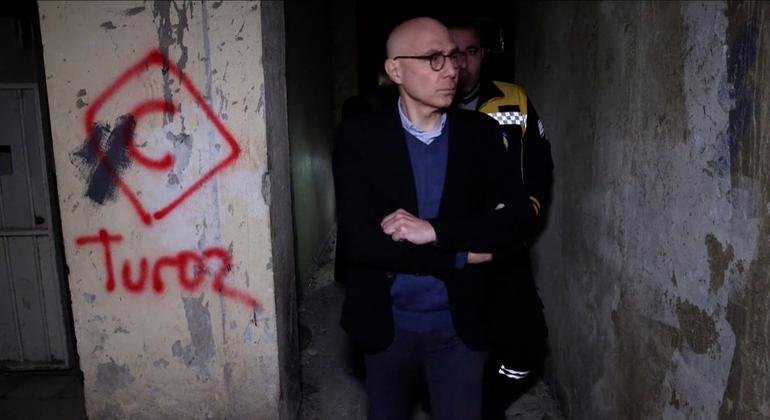
Faced with the accelerating deterioration of fundamental rights worldwide, the United Nations High Commissioner for Human Rights, Volker Türk, launched on February 5 a funding appeal of $400 million for 2026 — an amount presented as vital to keeping international protection mechanisms afloat.
Our estimated needs for 2026 amount to $400 million in voluntary contributions. At this critical time, this funding will enable us to defend all human rights for all people
he told Member States.
Beyond the financial appeal, the message is political: the international human rights architecture is entering an unprecedented zone of turbulence, caught between multiplying crises, challenges to international law, and shrinking resources.
International law under pressure
From Gaza to Sudan, from Yemen to Ukraine, as well as Venezuela and Haiti, grave violations are multiplying, placing UN mechanisms under constant strain.
Regarding the conflict in Gaza, the High Commissioner’s Office has repeatedly denounced breaches of humanitarian law and restrictions on humanitarian aid, recalling the obligations of parties under international law.
In other contexts, such as Venezuela, UN teams have had to suspend or scale down activities under political pressure, limiting independent monitoring capacities.
This accumulation of crises is mechanically increasing the demand for investigations, documentation, and victim protection — even as resources decline.
A financially weakened institution
This is the paradox: needs have never been higher, yet resources have never been so constrained.
“The cost of our work is modest; the human cost of underinvestment is immeasurable,” Volker Türk warned.
The Office of the High Commissioner operates largely on voluntary contributions, yet these are declining. In 2025, of the $500 million requested, only about $260 million was mobilized.
At the same time, the UN regular budget allocation has been reduced. For 2026, it stands at $224.3 million, down roughly 10%. This contraction comes amid a broader liquidity crisis affecting the UN system, fueled by delayed or suspended contributions from several major States.
Concrete impacts on the ground
This financial fragility is not abstract — it is already producing operational consequences.
In Myanmar, human rights office activities have been cut by more than 60%. In Honduras, security sector reform programs have been scaled back. In Chad, support for nearly 600 arbitrarily detained prisoners was suspended due to lack of funding.
More broadly, Human Rights Council investigative mechanisms have seen their capacities curtailed: missions canceled, staff reduced, investigations shortened.
The Office has also lost around 300 staff members and closed or downsized offices in 17 countries.
A pillar of multilateralism at risk
For Volker Türk, the stakes go beyond the administrative survival of his institution — they concern the balance of the multilateral system itself.
“Our reports provide credible information on atrocities and human rights trends at a time when truth is being eroded by disinformation and censorship,” he stressed.
In an increasingly polarized international environment, where some powers openly challenge universal norms, independent documentation capacity is becoming strategic.
Maintaining protection despite constraints
Despite these limitations, the Office remains highly active: 1,275 staff deployed across 87 countries, more than 5,000 human rights monitoring missions conducted in one year, and direct support provided to 67,000 survivors of torture and contemporary forms of slavery.
The agency also says it helped secure the release of more than 4,000 arbitrarily detained individuals worldwide.
But without additional funding, these actions could be drastically reduced.
An appeal revealing a systemic crisis
The $400 million appeal therefore goes beyond simple budgetary logic. It acts as a warning signal — revealing an international human rights system weakened at the very moment violations are multiplying and international law is being openly challenged.
In this context, funding human rights amounts, for the United Nations, to defending one of the last institutional bulwarks against global impunity.