

United Arab Emirates : between massive investments, strategic diplomacy and structuring projects
The United Arab Emirates (UAE) are now emerging as one of the most active partners on the African continent. Between 2019 and 2023, Abu Dhabi says it committed more than $110 billion in direct investments in Africa, placing the country among the main drivers of external economic development on the continent.

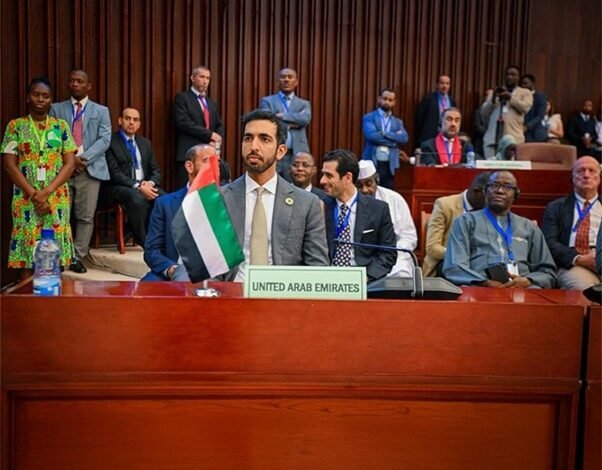
Sheikh Shakhboot bin Nahyan Al Nahyan strongly represented the voice of the United Arab Emirates at the 39th African Union Summit. Minister of State at the Ministry of Foreign Affairs, he outlined on February 15, 2026, from the podium of the African organization in Addis Ababa, Ethiopia, the actions carried out by his government across the continent in the areas of investment, trade, finance and dialogue.
According to the Minister of State for Foreign Affairs, Sheikh Shakhboot bin Nahyan Al Nahyan, the UAE invested “more than $110 billion in Africa” between 2019 and 2023, an amount described as “the largest committed by any country during that period.”
These investments cover a wide range of sectors, with a strong focus on energy, green industries, infrastructure and logistics. More than $70 billion of this amount has been directed toward energy, particularly renewable and clean energy, a sector considered key for Africa’s industrialization and economic diversification.
Clean energy and energy transition: a central pillar
One of the main pillars of the UAE’s engagement is the energy transition. Within this framework, the Africa Green Investment Initiative, supported by the Etihad 7 platform, has mobilized around $4.5 billion to finance more than 60 projects in solar, wind, geothermal energy, battery storage and green hydrogen.
At the same time, the Emirati company Masdar is leading an African programme worth around $10 billion, with the objective of expanding access to electricity to up to 100 million people by 2035, notably through solar and renewable energy projects.
This comes at a time when more than 600 million Africans still lack reliable access to electricity, an energy deficit that continues to hinder economic and social development.
Strengthening the diplomatic network
This economic expansion is accompanied by a strengthening of the diplomatic network. The UAE currently operates 19 embassies in Sub-Saharan Africa, with additional openings planned, reflecting a strategy aimed at strengthening both political and economic proximity.
At the same time, several African countries are expanding their diplomatic presence in Abu Dhabi, as the Emirati capital positions itself as a hub for trade, finance and dialogue with the continent.
Trade agreements and major infrastructure projects
The UAE has signed nine Comprehensive Economic Partnership Agreements with countries such as Nigeria, Kenya, Angola and the Democratic Republic of Congo. These agreements aim to facilitate trade, protect investments, strengthen customs cooperation and promote digital trade, complementing the African Continental Free Trade Area (AfCFTA).
In the field of port and logistics infrastructure, major projects are underway: a $1 billion modernization of the Port of Dar es Salaam in Tanzania and the construction of a new container terminal in Luanda, designed to increase connectivity and trade flows.
40% of their foreign aid directed toward Africa
Emirati authorities estimate that nearly 40% of their foreign aid over the past decade, amounting to around $21 billion, has been directed toward African countries. This assistance includes development, humanitarian and charitable initiatives, with the stated goal of promoting technology transfer and strengthening local capacities.
Furthermore, the United Arab Emirates will co-chair the United Nations Water Conference with Senegal in December 2026, illustrating their involvement in global issues such as water security and sanitation.