


The World Seen from Africa : AI Data Centers in Space ?
Faced with the exploding energy demands of artificial intelligence (AI), some of the world’s largest tech companies are considering a bold solution: placing data centers in orbit around the Earth. A crazy gamble? Not necessarily…

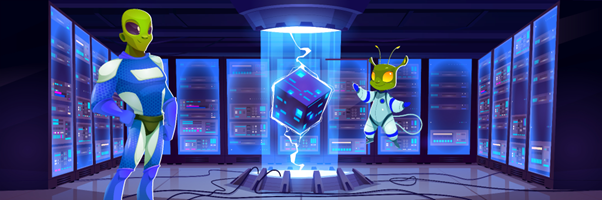
Artificial intelligence consumes enormous amounts of energy. Today, terrestrial data centers use huge amounts of electricity — some hyperscale facilities can consume several hundred megawatts, equivalent to the energy needed to power a small city. As AI continues to grow, pressure mounts on power grids, water for cooling, and available space on Earth.
Project Suncatcher: Installing Data Centers in Space, Powered by Solar Energy
To address these challenges, Google unveiled Project Suncatcher in 2025, an initiative to deploy data centers in space, powered by solar energy. The idea is to launch a constellation of about 80 solar satellites in low Earth orbit, equipped with high-performance AI processors (TPUs) that would communicate with each other via laser optical links rather than fiber, while taking advantage of almost constant sunlight.
Google CEO Sundar Pichai indicated that test launches could begin in 2027, with small racks of machines onboard satellites to validate the technology. He said that within a decade, these extraterrestrial data centers could become commonplace, especially if launch costs continue to fall.
The logic behind this approach is simple: in space, solar energy is far more abundant and consistent than on Earth, where night, clouds, and the atmosphere reduce the efficiency of solar panels. In addition, the vacuum of space would allow server heat to dissipate more efficiently by radiation rather than using huge amounts of water and electricity for cooling.
SpaceX, Blue Origin, and Other Major Players Enter the Race
Other major players in the space and tech sectors are also positioning themselves in this field. SpaceX, Elon Musk’s company, is working on adapting its Starlink satellite constellation to host AI computing payloads, and may potentially introduce its own orbital data centers using advanced satellite technologies starting in 2026, according to recent announcements. Meanwhile, Blue Origin, Jeff Bezos’ aerospace company, is also developing technologies that could support orbital data centers within the next decade.
Major Technical Challenges…
However, the technical challenges are enormous. Engineers must solve communication latency issues, maintain satellites close enough for very high-speed data exchange, and ensure component reliability against space radiation and extreme temperatures. Launch costs also remain very high, even with the gradual reduction in space transport prices.
Some experts believe that these concepts may not provide an immediate solution to AI’s energy needs, but rather serve as a complementary long-term technology — particularly for space applications or AI tasks less sensitive to latency. In any case, the interest of tech giants shows that what once seemed like science fiction is now being studied seriously, with concrete early tests expected by the end of this decade.