

Success story : Vincent Dakuyo, land as a legacy and women as a driver of performance
The son and grandson of farmers in Burkina Faso, Vincent Dakuyo has never left the land, even when his studies and professional opportunities could have taken him elsewhere. Founder of CABRE SA, he has transformed a rural inheritance into a structured, inclusive and profitable agro-industrial model. By placing women at the heart of his production system, he demonstrates that in Africa, family farming—when modernized and well organized—can become a powerful lever for value creation, resilience and food sovereignty.

For Vincent Dakuyo, agriculture is neither a slogan nor an opportunistic career shift. It is a story of family, territory and responsibility. “I was born into it. My father was a farmer, my grandparents too. I never imagined my life away from the land,” he says. There were eight children at home, all girls before him; as the first boy, he grew up with the conviction that one day he would have to support his family.
I never really chose agriculture; it imposed itself on me… and I love it
Although he pursued university studies up to a master’s degree, returning to the village was never in question. “Even after my studies, I couldn’t see myself staying in the city. I was too attached to the land,” he explains. Very early on, he launched agricultural initiatives, tested, experimented and sold surplus production. “It was almost instinctive. I never really chose agriculture; it imposed itself on me. And I love it—I love the land…”
I realized that producing was no longer enough. We had to structure, modernize and think of agriculture as a business
The real turning point came in 2005, when he took part in a training program in agricultural entrepreneurship while working as a consultant, notably with GIZ. “I realized that producing was no longer enough. We had to structure, modernize and think of agriculture as a business.” Price volatility, unsold stocks and missed markets raised an obvious question: why not process locally?
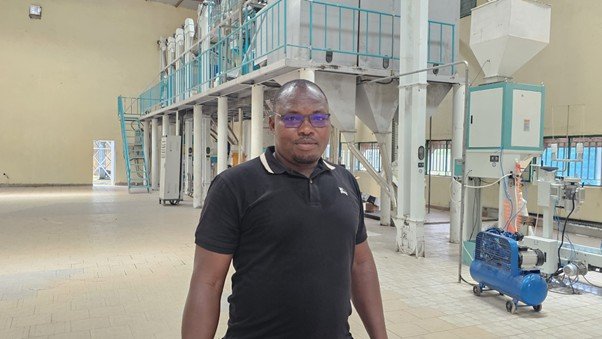
In 2020, the industrial project took shape. Vincent Dakuyo amended the company’s statutes and committed to an ambitious investment estimated at nearly 890 million CFA francs. He mobilized his own savings and personally handled supplier prospecting, in Turkey and China. “I did my business plan myself. I analyzed everything, step by step.”
The industrial journey was tough. Investments quickly exceeded one billion CFA francs. Bank credit proved difficult to secure. Then the Covid-19 pandemic hit. “The machines weren’t arriving, but repayments had already started. Fortunately, my bank stood by me.” The equipment was finally delivered at the end of 2021, enabling the actual start of processing activities in 2022.
At the heart of the CABRE SA model, a deliberate choice: betting on women
At the core of CABRE SA’s model lies a clear and deliberate choice: betting on women. “In our regions, it is women who carry food crop production. Agriculture, for us, is first and foremost about women.” Today, the company works with 34 cooperatives bringing together more than 3,000 producers, including around 1,800 women, spread across some thirty villages and organized by value chain.
For Vincent Dakuyo, the cooperative model is a strategic key. “No institution finances unstructured producers. The cooperative enables access to financing and compensates for the lack of land titles, especially for women.” His assessment is unequivocal: “Women are more organized, more consistent, more reliable. Repayment rates are better.”
This trust is also reflected internally. “My strongest collaborations are with women. Some have been with me for more than seven years. There is remarkable loyalty and a strong sense of responsibility.” The result: nearly €2 million in revenue, generated through a model built on financing, equipment, technical support and local processing.
Climate change forces us to do things differently. We must accept that the environment has changed and adapt our production methods
Yet the entrepreneur remains clear-eyed about the challenges ahead. “Climate change forces us to do things differently. We must accept that the environment has changed and adapt our production methods.” Every year, CABRE SA invests in training producers, soil management and conservation techniques. “Technology is essential, but it is still difficult to access. Even simple tools, like measuring grain moisture, are not within everyone’s reach.”
His message is clear and straightforward: “What is missing today is investment—first and foremost, investment in training.”
Through his journey, Vincent Dakuyo embodies an African agriculture that is deeply rooted, modernized and forward-looking—one in which women’s capital becomes a true engine of sustainable performance.