

Saudi Arabia‑Africa: Accelerated Economic Diplomacy at the Heart of Continental Transformations
The visit of Saudi Arabia’s Deputy Foreign Minister, Waleed ElKhereiji, to Rwanda on March 25, 2026 illustrates the deepening bilateral relations between Saudi Arabia and African states. In a global context marked by geopolitical rivalries and reorientation of international investment flows, Riyadh is betting on a strategy of sustainable financing, institutional partnerships, and structured cooperation to strengthen its role in Africa. By the editorial team

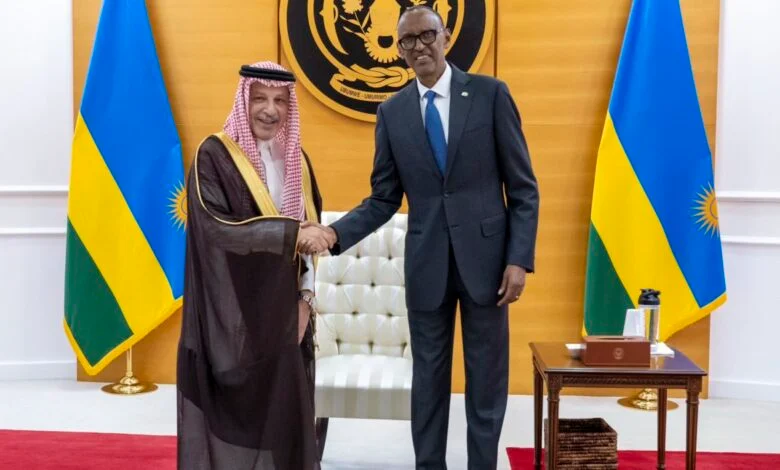
The meeting between Paul Kagame and Waleed ElKhereiji in Kigali reflects a Saudi strategic approach aimed at diversifying economic cooperation and foreign direct investment flows toward Africa. Discussions focused on priority sectors such as infrastructure, renewable energy, technology, and industrial transformation — essential elements to support Rwanda’s economic growth.
57 % of Saudi Fund for Development Financing Committed in Africa
This diplomatic offensive comes as Saudi Arabia increases its presence on the continent through the Saudi Fund for Development (SFD). Established in 1975, the SFD has financed more than 800 projects totaling USD 20 billion in over 100 countries, of which over 400 projects worth USD 10.7 billion have been implemented in Africa — accounting for 57 % of the fund’s commitments in developing countries worldwide.
These funds target social and economic infrastructure, access to water, healthcare, education, and transportation, with amounts ranging from USD 20 million for water systems in Kigali to USD 75 million for a mother‑and‑child hospital in Guinea.
On the impact of these commitments, H.E. Sultan Al‑Marshad, CEO of the SFD, said: “The SFD is proud to continue in partnering with African countries through contributing towards supporting development projects that will have a tangible impact on the lives of millions of people. With these new agreements and MoU, we are taking a step further towards a brighter and more equitable Africa. By contributing to healthcare, education, water, and transportation projects, we are supporting the empowerment of millions of people to reach their full potential and build a more sustainable and economically prosperous continent for future generations.”
A Saudi Economic Strategy Amid a Turbulent Global Context
This Saudi economic strategy unfolds in a broader international context marked by the escalation of the Middle East warthat began on February 28, 2026, after the United States and Israel carried out coordinated strikes against Iran, triggering a major regional conflict and prompting retaliatory missile and drone attacks across the Persian Gulf — including on Saudi territory.
The conflict has already disrupted global markets: emerging market debt issuance has stalled, borrowing costs have risen, and capital has flowed toward perceived safe‑haven assets, while oil prices remain sensitive to supply risks amid continued instability in the Strait of Hormuz — a key route for roughly 20 % of the world’s petroleum trade.
For Saudi Arabia, this geopolitical turmoil presents strategic challenges. The kingdom and other Gulf states have publicly warned of rising threats from Iran‑aligned militias and proxies, highlighting increased security risks linked to the broader conflict.
Sovereign Wealth Funds and Long‑Term Capital in Africa
In this context of persistent tensions, Riyadh balances its economic influence in Africa with efforts to safeguard its own regional stability. For African partners, Saudi engagement represents both an opportunity and a challenge. On one hand, access to stable financing helps close structural investment gaps and supports projects aligned with the United Nations Sustainable Development Goals (SDGs). On the other hand, geopolitical instability introduces an added risk premiumthat can affect credit costs, commodity prices, and the reliability of supply chains connecting the Gulf to Africa.
As Bruno Cabrillac, Director of the Foundation for Studies and Research on International Development (FERDI), emphasizes: “The role of sovereign wealth funds like that of Saudi Arabia is to mobilize long‑term capital, essential to help fill investment gaps in Africa, particularly in social and economic infrastructure.”
Aligned with Saudi Vision 2030
In parallel, the Saudi strategy also aligns with Vision 2030, which seeks to diversify the Saudi economy and reinforce its global role. Africa represents fertile ground for investments that address both economic objectives — job creation, diversification of trade — and geopolitical ambitions, by consolidating alliances at a time of heightened global uncertainty.
Tags EN: Saudi Arabia Africa economic diplomacy investment sustainable development SFD Vision 2030 Rwanda SDGs geopolitical risk Middle East war emerging markets cooperation