


Report : growth returns, but the specter of debt and inflation continues to haunt the economy
Africa is expected to record growth of 4% in 2026, according to the World Economic Situation and Prospects 2026 report published by the United Nations. A rebound driven by East Africa, but one that masks persistent challenges…


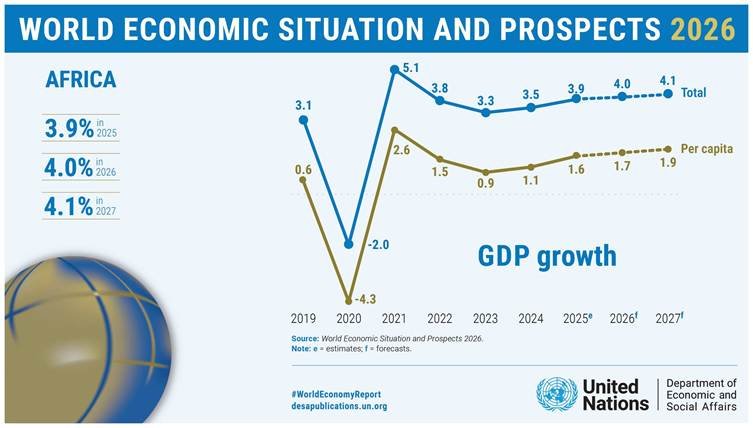
Africa is approaching a symbolic milestone: average growth of 4% in 2026, up from an estimated 3.9% in 2025, according to the United Nations’ World Economic Situation and Prospects 2026 report, marking a relative recovery despite an uncertain global context. This momentum, the UN notes, is unfolding in an environment characterized by “fiscal constraints, high debt-servicing costs, and persistent food inflation,” all of which weigh on the continent’s sustainable development trajectory.
East Africa in the lead, driven by the performance of Ethiopia and Kenya
East Africa stands out as the most dynamic sub-region, with growth projected at 5.8% in 2026, driven in particular by the strong economic performances of countries such as Ethiopia and Kenya, supported by regional integration and the expansion of renewable energy. By contrast, other sub-regions remain more modest: West Africa at 4.4%, North Africa at 4.1%, Central Africa at 3.0%, and Southern Africa at 2.0%.
The burden of debt remains…
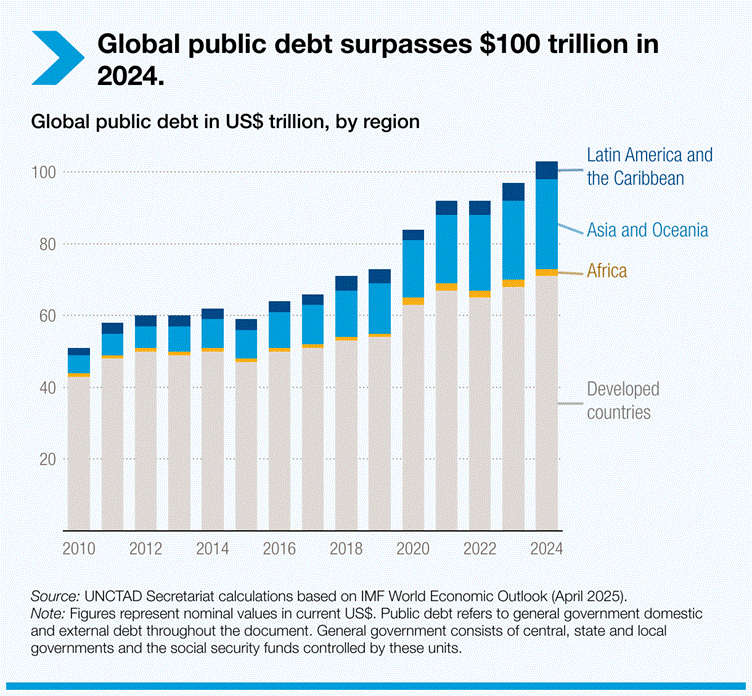
But clouds are gathering on the horizon. The UN report highlights that the average debt-to-GDP ratio of African countries will reach around 63% in 2025, with debt-servicing costs absorbing a significant share of public revenues. Around 40% of African countries remain either in debt distress or at high risk; some are seeking to restructure their debt under the G20 Common Framework.
From the perspective of international central banks, the World Bank’s Global Economic Prospects report notes that “global growth remains moderate and less capable of generating strong expansion,” while remaining “relatively resilient to uncertainties in trade policies.” This dynamic indirectly affects Africa, where access to financing, reserve stability, and reducing vulnerability to external shocks remain major challenges.
Similarly, in several African economies, the overall decline in inflation does not signal an end to pressure on households. The World Bank estimates that median inflation in Sub-Saharan Africa fell from 7.1% in 2023 to around 4.5% in 2024, but the prices of food products and basic necessities continue to weigh on low-income households, limiting their purchasing power.
Trade and economic integration
In this context, the UN report also stresses that mechanisms such as the African Growth and Opportunity Act (AGOA), whose continuity is being questioned by new measures adopted by the United States since Donald Trump’s return to power, and the implementation of the African Continental Free Trade Area (AfCFTA) are crucial for African economic integration. Uncertainties surrounding their application, along with the emergence of new trade barriers, could hinder the integration of the continent’s economies into global value chains.
Towards sustainable growth?
The report concludes that “African growth can remain resilient, but it will only be sustainable if it is accompanied by structural reforms and enhanced coordination of national and regional policies.” This approach includes prudent fiscal policies, strengthened reserves, investment in key social sectors (education, health), and increased cooperation at the international level.
Consult the report : World Economic Situation and Prospects 2026