

President John Dramani Mahama : ”The trade of enslaved Africans and racialised forms of slavery are foundational crimes that shaped the modern world”
At the 39th African Union Summit in Addis Ababa, under the theme “Ancestral Debt, Modern Justice: Africa’s Unified Case for Reparations,” President John Dramani Mahama outlined Ghana’s stance, advancing a unified continental call for historical accountability and restorative justice for the transatlantic slave trade, colonialism, and apartheid.

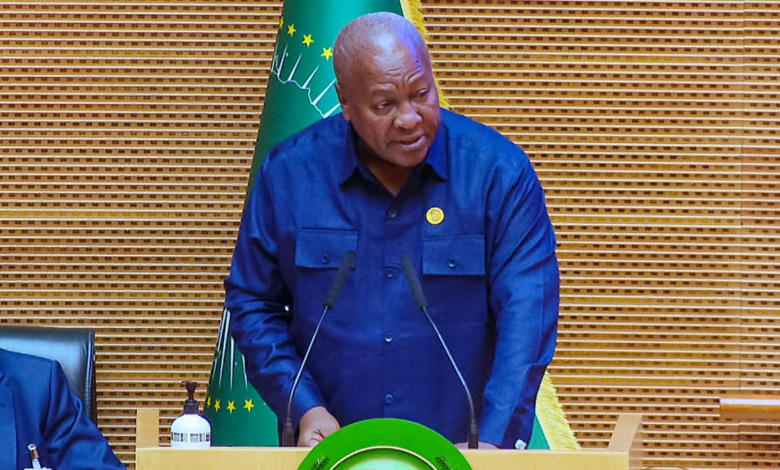
By President John Dramani Mahama
I address you today with a deep sense of history and responsibility.
In February 2024, the Assembly of Heads of State and Government of the African Union adopted Decision 884, declaring 2025 as a year of justice for Africans and people of African descent through reparations. Reparations for the transatlantic slave trade, colonialism, and apartheid were designated as a flagship priority of our Union. In line with that decision, I was entrusted with the mandate to serve as African Union Champion for Reparations.
This is not merely a title, it is a solemn obligation to pursue truth, recognition, and justice for our ancestors and for generations yet unborn. At the 80th session of the United Nations General Assembly in September 2025, I announced that Ghana would lead the effort to table a resolution declaring slavery and the transatlantic slave trade as the gravest crime against humanity. That commitment marked the beginning of a structured diplomatic and legal process.
I directed the Ministry of Foreign Affairs to establish a high-level committee to coordinate consultations, refine the legal framework, and prepare a draft text consistent with international law and diplomatic practice. Today I am pleased to report significant progress. The initiative is firmly grounded in international law.
Slavery is prohibited under international law as a peremptory norm. A juice co-joins principle from which no derogation is permitted. The resolution builds upon this legal foundation and rests on three pillars.
First is historical accuracy. Second is legal defensibility. And third is continental and diaspora alignment.
We have ensured that the text of this resolution reflects rigorous scholarship, moral clarity, and diplomatic credibility. Ghana has undertaken extensive consultations to strengthen the resolution. We have engaged with UNESCO, the Global Group of Experts on Reparations, the Pan-African Lawyers Union, academic institutions, the African Union Committee of Experts on Reparations, and the African Union Legal Experts Reference Group.
We hosted the inaugural joint meeting of the African Union Committee of Experts on Reparations and the African Union Legal Experts Reference Group in Accra earlier this month to further refine the text of the resolution. We also began engagement with the diaspora at the Ghana Diaspora Summit held in December last year. This has been inclusive, deliberate, and consultative.
Following expert consultations, the title has been refined to read, Declaration of the Trafficking in Enslaved Africans and Racialized Chattel Enslavement of Africans as the Gravest Crime Against Humanity. This language is precise. It recognizes the systematic trafficking of millions of Africans, the racialized and institutionalized nature of chattel enslavement, the unprecedented scale and enduring consequences of these crimes.
Precision in language strengthens precision in justice. At the recent African Union Summit, the Executive Council recommended the endorsement of this resolution. I am pleased to inform you that the Assembly of Heads of State and Government adopted that decision by consensus at this 39th Ordinary Session.
This gives Ghana a clear and unified continental mandate. Our next major engagement will be at the 50th Regular Meeting of CARICOM later this month. The Caribbean and Africa share a deeply intertwined history, and their support will be pivotal to the tabling of this resolution.
Beginning 20 February 2026, Ghana will conduct intensive diplomatic engagements in New York with CARICOM, the Non-Aligned Movement, the Group of 77 in China, the European Union, and other regional groupings. Informal consultations on the draft text are expected to take place between 23 February and 12 March 2026. Our objective is simple, to build a broad consensus behind this resolution.
The initiative is not directed at any nation. It is directed towards truth, recognition, and reconciliation. On 24 March, Ghana will host a high-level side event at the United Nations, followed by a wreath-laying ceremony at the African Burial Ground National Museum in New York.
And on 25 March 2026, the International Day of Remembrance of the Victims of Slavery and the Transatlantic Slave Trade. Ghana, together with co-sponsors and with the endorsement of the African Union, will formally table the resolution before the General Assembly. Let me emphasize, the General Assembly.
I think there was a mistake when the Chairman said the Security Council. It is the General Assembly. The date is intentional because it connects memory with action.
We call upon all Member States to support and co-sponsor this resolution. The adoption of this resolution will not erase history, but it will acknowledge it. The trafficking in enslaved Africans and racialized chattel enslavement were foundational crimes that have shaped the modern world.
And their consequences continue to manifest in structural inequality, racial discrimination, and economic disparity. Recognition is not about division. It is about moral courage.
Adoption of the resolution will not be the end. Following the adoption, Ghana will continue engagement with the United Nations Secretary General, the African Union Commission, relevant UN bodies, and interested Member States. This is about a sustained dialogue on reparatory justice and healing.
Distinguished Ladies and Gentlemen, this initiative presents us a historic opportunity, an opportunity to affirm the truth of our history, an opportunity to recognize the greatest injustice in human history, an opportunity to lay a stronger foundation for genuine reconciliation and equality. While the past cannot be undone, it can be acknowledged. And acknowledgement is the first step towards justice.