

Politics : they are taking power
From Samia Suluhu Hassan to Netumbo Nandi-Ndaitwah, how women are rising to the top of African states and transforming governance. In 2026, a new generation of African women leaders holds positions of power that were once rarely accessible to women. Presidents, vice presidents and influential ministers are redefining governance across the continent and paving the way for more inclusive representation — despite persistent challenges.

By Hawa Sidibe
Across the African continent, women’s influence in political life continues to grow, even though full equality remains far from achieved. Around 13% of executive positions (president, vice president, prime minister) are held by women in 2025, an increase compared to 2021 but still a minority relative to the total number of African leaders, according to the Barometer of Women’s Political Participation in Africa.
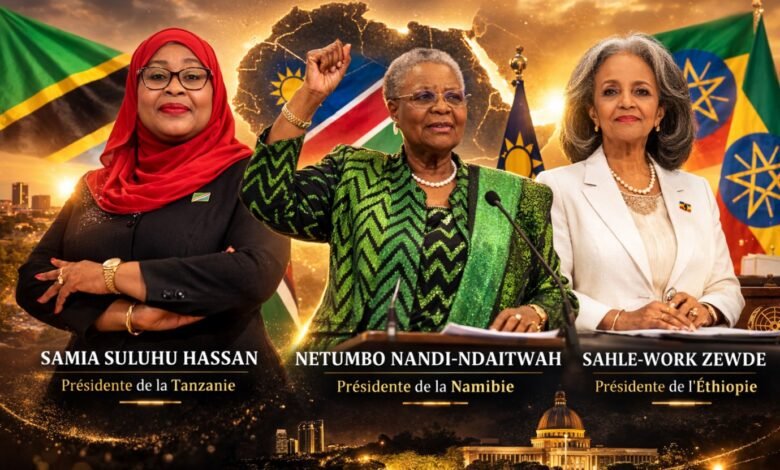
At the forefront of this transformation, two emblematic figures illustrate this turning point: Samia Suluhu Hassan, President of Tanzania, and Netumbo Nandi-Ndaitwah, President of Namibia. Samia Suluhu Hassan assumed leadership of Tanzania, becoming the first woman to lead the country and establishing herself as a key actor in regional diplomacy and development efforts in East Africa.
Netumbo Nandi-Ndaitwah, elected President of Namibia in March 2025, made political history by becoming the first woman to accede to the highest office through the ballot. Her presidency is rooted in a long trajectory of public service and reflects the country’s commitment to reducing gender inequalities. Under her leadership, 57% of ministerial portfolios are held by women, a symbolic indicator of commitment to more representative cabinets.
At the executive level, other countries are also showing notable progress. Sahle-Work Zewde, President of Ethiopia, was among the first African women leaders to serve as head of state, contributing to strengthening the visibility of women in the highest positions of power.
The emergence of Jane Naana Opoku-Agyemang as Vice President of Ghana marks another important milestone: her academic and political career illustrates the gradual opening of decision-making spaces to women in evolving African democracies.
Female representation in African parliaments stands at around 24% of seats, close to the global average
Despite these advances, women remain largely underrepresented in spheres of power. Data show that female representation in African parliaments stands at around 24% of seats, close to the global average; however, it remains far from the parity sought and from the African Union’s target of at least 50% representation by 2030.
Progress is not limited to heads of state. In many countries, women hold senior responsibilities in ministerial cabinets, legislative assemblies and international institutions, helping shape more inclusive public policies and promoting priority areas such as education, health and equal opportunity.
Structural, cultural and institutional barriers
However, women’s integration at the highest levels of political decision-making continues to be constrained by structural, cultural and institutional barriers. Across the continent, political parties, electoral systems and social norms often disadvantage female candidacies, limiting access to key responsibilities.
Nevertheless, the advances are undeniable: more women are running for executive office, reforms are underway to expand access to representation, and networks of support among African women leaders are developing. Mentorship initiatives, leadership platforms and institutional commitments demonstrate that transformation is in motion.