

Industry Summit in Riyadh : towards a fairer and greener economic growth?
The Global Industry Summit 2025 (GIS 2025), hosted by UNIDO — the United Nations Industrial Development Organization — concluded in late November in Riyadh. While the ambitions are high — sustainable industry, youth inclusion and training, international cooperation — the tangible benefits for developing countries, particularly in Africa, remain uncertain.

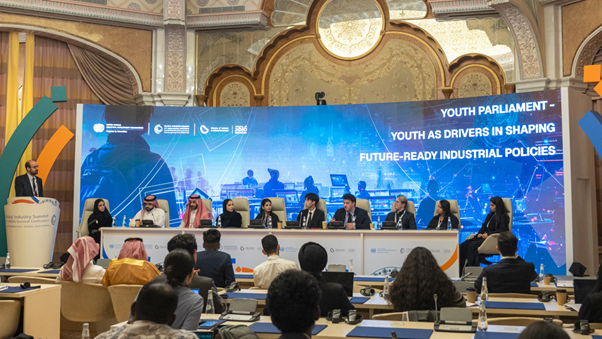
Since the opening of GIS 2025, organizers have not hidden their hopes of seeing the global industry reinvent itself on more sustainable, inclusive, and resilient foundations. During the inaugural session, UNIDO’s Director General praised Saudi Arabia’s initiative as a model — a “regional model” of industrial transformation combining modern technologies, renewable energy, innovation, and political will.
The summit also officially launched the “Industrial Development Report 2026” and the “UNIDO Vision 2050,” key frameworks outlining what the industry of tomorrow could look like: greener, more digital, and more equitable, especially for countries that have struggled to move beyond extractive or weakly manufacturing-based economies.
For Saudi Arabia, the vision is ambitious: the industrial project pipeline exceeds $500 billion, aiming for 36,000 factories by 2035. Opportunities span diverse sectors, including electric vehicles, downstream chemicals, pharmaceuticals, and renewable energy. The country reports having identified over 800 industrial “opportunities” over this period.
Yet, despite these promises, the response remains cautious. Translating these ambitions into reality requires conditions rarely met, especially outside Saudi Arabia.
An Attractive but Hard-to-Export Model
Saudi Arabia’s experience — massive investments, industrial planning, support for advanced technologies, and vocational training — serves as a showcase of what a resource-rich state with political will can achieve. Transposing this model to Africa is not straightforward. Many African countries face structural weaknesses: insufficient infrastructure, often unreliable energy access, and limited industrialization — with the manufacturing sector remaining a small share of GDP in many nations.
Moving toward “green industrialization,” as promoted by UNIDO, demands capital, technology, robust regulatory frameworks, and governance capable of avoiding pitfalls such as resource dependence, pollution, or social and environmental externalities. Many African countries face significant challenges in these areas.
Another key obstacle is cost: modern “green” technologies — in energy, digitalization, or automation — are often more expensive than traditional processes. In the context of tight budgets and competing priorities (health, education, basic infrastructure), it is difficult for African states to mobilize the resources required for sustainable industrialization, raising the risk of reverting to fossil-fuel-intensive industries or chronic underinvestment.
The Opportunity for Africa: Leveraging Technology Transfers and Partnerships
The summit provides a framework for international dialogue and cooperation that could benefit Africa. The challenge is to use this moment to negotiate technology transfers, tailored partnerships, and targeted financing to build new industrial value chains rather than remain reliant on raw material exports.
A “green and modern” approach offers real advantages: Africa, not yet entrenched in highly polluting production modes, could avoid the mistakes of past industrialization and integrate into global value chains with higher added value — in sustainable agro-industry, renewable energy, biotechnology, industrial services, and more. As a recent report notes, “green industrialization” can provide a competitive advantage if policies, energy, and infrastructure are aligned.
However, this requires African states, with international support, to pursue deep reforms: governance, investment attractiveness, innovation support, training, and regulatory frameworks aligned with environmental and social standards.
A Strategic — and Risky — Choice
GIS 2025 highlights that the industrial world is entering a phase of transformation: digital, green, and globalized. For Africa, this may be an opportunity, but fully embracing it demands clear strategic choices. Continuing “traditional” industrialization (raw materials, extraction, low processing) remains possible — but for how long, in a context of increasingly demanding global markets?
Shifting toward modern and sustainable industrialization appears more ambitious — and potentially more beneficial long-term — but risks are high: initial costs, dependence on external financing, and institutional fragility.
Far from being a miraculous pact, the model promoted in Riyadh appears as an invitation to rethink industry — but also as a major challenge, a long-term bet for Africa. This bet can pay off — provided policies are tailored, robust, and coherent, and ambition does not outpace the realities on the ground.