

Ibrahim Mahama : who is the ghanaian artist becoming the first african to top the power 100 ?
Ghanaian contemporary artist Ibrahim Mahama has made history by becoming the first African to top ArtReview’s Power 100, one of the most prestigious rankings in the art world. Here’s a look at the journey of a committed creator whose monumental installations and institutional projects are reshaping the contemporary art landscape in Ghana and beyond.


Born in 1987 in Tamale, Ghana, Ibrahim Mahama is now considered one of the most influential voices in global contemporary art. After studying painting and sculpture at the Kwame Nkrumah University of Science and Technology (KNUST) in Kumasi, he became known for monumental works addressing history, labor, global economy, and colonial legacies.
On December 4, 2025, Mahama was ranked number 1 on ArtReview’s Power 100, an annual list compiled by an international jury of experts recognizing the people and institutions that have most shaped the contemporary art world during the year. He moved up from 14th place in 2024 to the top spot in 2025, an unprecedented rise for an African artist.
« For me to be part of this, especially coming from a place like Ghana, which for many years was almost as if we were not even part of the discourse, is quite humbling, » Mahama said about this historic recognition, highlighting how his personal achievement carries symbolic weight for African artists.
An Artist of Material and Memory
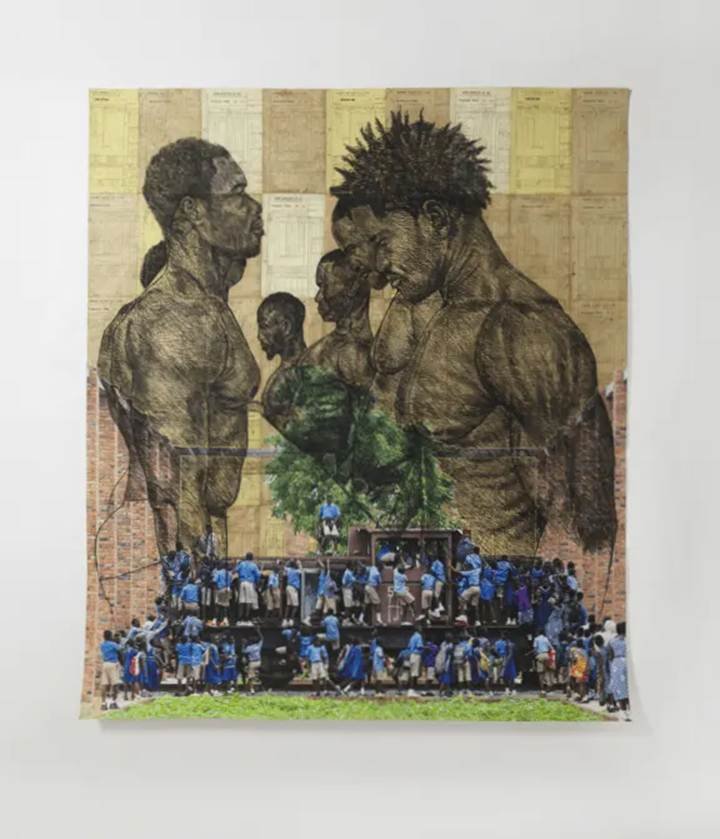
Mahama’s practice is marked by the use of repurposed materials—jute sacks, used textiles, hospital beds, and decommissioned train wagons—which he transforms into spectacular installations. These materials are chosen deliberately: they often relate to commercial dynamics, labor exploitation, or global trade networks, particularly those that shaped Ghana’s economic history.
His works have been exhibited in prestigious venues across continents, including Fruitmarket Gallery in Edinburgh, where Songs About Roses explored the history of railways built under British colonialism, and at London’s Barbican Centre, where he draped a massive 2,000 m² pink canvas over the building’s façade.
A Builder of Artistic Ecosystems
Beyond his art, Mahama has established cultural institutions. Using proceeds from his sales, he invested in creating spaces for art and training in his hometown of Tamale: the Savannah Centre for Contemporary Art (SCCA), the Red Clay Studio, and Nkrumah Volini. These spaces function as residencies, creative labs, exhibition venues, workshops for young artists, and archival centers.
This approach reflects a new dynamic in the art world, where artists are not only individual creators but also actors building collective ecosystems, supporting local talent while engaging internationally.
Global Influence
The 2025 Power 100 ranks not only artists but also highlights a trend: contemporary art is opening up to new geographies and new ways of producing, disseminating, and experiencing art. At the top of the ranking, Mahama embodies this diversity alongside influential figures from the Middle East, Europe, and Asia. His leading position is hailed as a paradigm shift, emphasizing the emergence of a global art world where the African voice now occupies a central place.
In addition to his artistic influence, Mahama remains committed to teaching and theoretical reflection: he is pursuing a PhD in painting and sculpture at KNUST, demonstrating how artistic creation can be nourished by academia and contribute to transforming cultural discourse.
Ibrahim Mahama’s recognition as the first African to dominate the Power 100 is more than a personal achievement: it is a collective acknowledgment of the vitality of contemporary African art, its impact, and its capacity to shape new perspectives in the global art world.