

Geopolitics : Algeria joins UN Security Council, returns to a new world stage
Sierra Leone and Algeria will join the UN Security Council on January 1, 2024 as part of the traditional rotating membership process. But for Africa's largest country, this is a new step that marks its return to the new world stage. Analysis.

By Mérième Alaoui
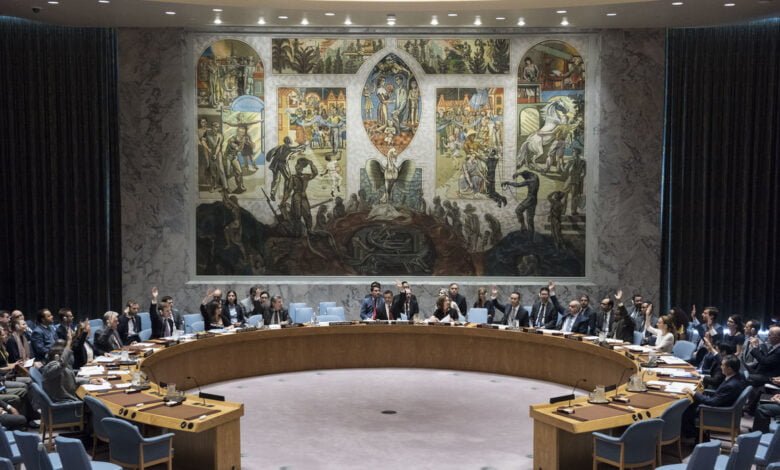
The General Assembly voted, on June 6, 2023, to elect two new African countries to the UN Security Council for a two-year term. Sierra Leone and Algeria were elected by secret ballot, with 188 and 184 votes respectively, from the organization’s 193 member states. Francis Laloupo, a journalist and researcher specializing in African geopolitics, said this election is really « a symbolic step within the United Nations, a kind of protocol procedure that is not very decisive. But it is also an opportunity for countries to highlight their own specific issues and raise their profile. Sierra Leone, for example, will focus on security and good governance.”
For his part, Sierra Leone’s Foreign Minister David Francis believes that « it is a great day for this small, progressive and self-confident country (…) which has successfully made the transition from war to peace, to return to the Council after 53 years ». For Algeria, this is its fourth return to the Council.
« After the successful chairmanship of the Arab League Summit, this election to the principal organ of the United Nations, the guarantor of the maintenance of international peace and security, confers on our country a special responsibility through participation in the global decision-making process within the Security Council, a new opportunity for our country to reaffirm its principles and values and share its vision, » the Algerian Presidency welcomed in a press release. « It should be noted that after the vote, the country unexpectedly positioned itself on the Women, Peace and Security program. This could be a good way to broaden its scope to include these universal issues, » said Françis Laloupo.
The country has unexpectedly positioned itself in the Women, Peace and Security program, which could be a good way to broaden its scope to include these universal issues
The Security Council is made up of 15 members, including five permanent veto-wielding members (the United States, Russia, China, France and the United Kingdom) and ten members elected on a rotating basis for a two-year term, half of which are renewed each year according to the rules of geographical distribution. For Sierra Leone, as for Algeria, this election, which was uncontested and without any real suspense, « is above all a new marker for the largest country in Africa (2,381,741 km² with a population of 43.9 million), confirming its return to the new world stage, » says Jean-Joseph Boillot, a researcher at IRIS. Boillot, who specializes in the economies of emerging countries, recalls that Algeria was one of the pillars of the non-aligned world in the 1960s after its independence: « With the Algiers Conference, » he recalls, « the priority was to protect against neo-colonial, neo-imperialist influence. This position was strengthened when the country became an oil and gas power, having regained its independence from the exploitation of hydrocarbons ». But after the Boumédienne era, in the 1990s, there was a weakening that led to a decade of relative silence, Jean-Joseph Boillot adds.
In its return to the world stage, Algeria can operate in two ways, according to the journalist Francis Laloupo. « The old way, reserved for the so-called Third World countries, with a more discreet diplomacy in the circle of nations. But also, with the capacity to be more offensive, this time dining at the table of the big boys like Brazil and others, » he analyzes.
This new situation comes at a time of great geopolitical change. Jean-Joseph Boil lot, a former diplomat, believes that long before the war in Ukraine, « we are witnessing the emergence of powers from the so-called Global South, which proves that we are indeed on the way to a post-1945 world. Algeria therefore has a role to play. China has a strong economic presence in the country and has overtaken France as a trading partner ». He goes on to point out that, on the other hand, “Russia is also urging its Algerian partner to exert diplomatic influence on Arab countries. Algerian diplomats are part of this first circle of international diplomacy, very smart and very cultured. They play a very important role. “
We are witnessing the emergence of the powers of the so-called Global South, which proves that we are indeed on the way to a post-1945 world
But while it is true that the crises in the Sahel are being played out in Algeria, the country is not particularly focused on the continent. « That has always struck me. Algeria sees itself as an international power, while its neighbor and competitor Morocco sees itself as a regional power, » says Jean-Joseph Boillot. This is why the North African country wants to join the BRICS. « This should be confirmed very soon », if the Iris researcher is to be believed. In his opinion, « joining Brazil, Russia, India, China and South Africa, by enlarging this club of high-profile emerging countries, is a perfect reflection of Algeria’s strategy ». A club that, once enlarged, possibly to 20 members by the end of the next summit on August 22 in South Africa, should, in his eyes, increasingly appear as a counter-G7 (Canada, France, Germany, Italy, Japan, United Kingdom, United States).
While Algeria, once integrated into the BRICS, should bring more of its diplomatic weight to bear on the Security Council for the two years allotted to it, the African Union continues to regularly deplore « the fact that the continent remains excluded from permanent membership, despite having more than a billion inhabitants and hosting 70% of UN missions ».
But for Francis Laloupo, « the Security Council no longer corresponds to geopolitical reality. The permanent members can no longer be seen as a beacon, a moral authority for the management of world affairs. « As I see it, there are two options. Either we widen the circle by including emerging countries like South Africa, Nigeria… Or we dissolve this body, » he declared.