


Food security: Africa faces urgent need to transform its agrifood systems
Held from 13 to 17 April 2026 in Nouakchott during the 34th FAO Regional Conference for Africa, policymakers and international experts are focusing on transforming agrifood systems as a key response to the food crisis, amid rising hunger, climate shocks, and structural vulnerabilities. By the editorial team

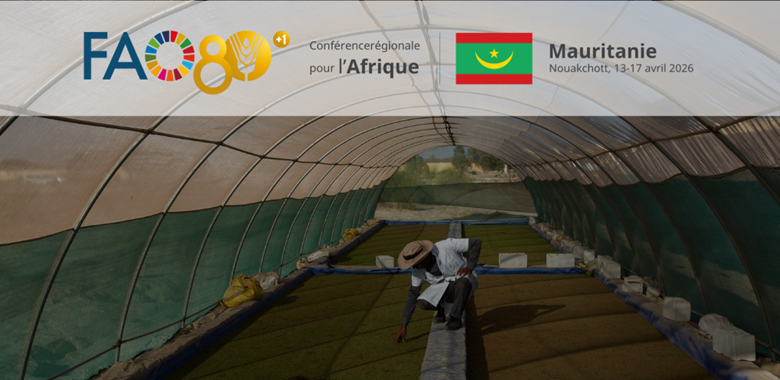
From 13 to 17 April 2026, Nouakchott is hosting the 34th Session of the Food and Agriculture Organization of the United Nations (FAO) Regional Conference for Africa. The meeting brings together agriculture ministers, experts, international organizations, the private sector, and civil society to address a central challenge: accelerating the transformation of agrifood systems to respond to the food and nutrition crisis.
According to the FAO, this conference is the organization’s highest regional governing body on the continent. It takes place in a context where African food systems are under multiple pressures: rapid population growth, natural resource degradation, global market volatility, and intensifying climate shocks.
A persistent and structural food crisis
Figures highlight the scale of the challenge. According to the State of Food Security and Nutrition in the World (SOFI) 2024 report published by FAO, IFAD, UNICEF, WFP, and WHO, nearly 735 million people were affected by hunger globally in 2023, with a significant share in Africa, where the trend remains particularly concerning despite ongoing efforts.
Transforming agrifood systems is essential to ensure global food security and improve resilience to crises
The same report notes that Africa remains the region most affected by food insecurity, with undernourishment prevalence above the global average. The FAO has repeatedly warned that current trajectories are not compatible with the goal of “Zero Hunger” by 2030.
As FAO Director-General Qu Dongyu stated: “Transforming agrifood systems is essential to ensure global food security and improve resilience to crises.”
Agrifood systems under pressure
African agricultural systems remain heavily dependent on rain-fed farming, making them highly vulnerable to climate variability. Recurrent droughts in the Horn of Africa and Southern Africa, as well as floods in parts of West Africa, are disrupting agricultural cycles.
In addition, FAO estimates that post-harvest losses can reach up to 30–40% in some agricultural value chains, due to insufficient storage, transport, and processing infrastructure.
These losses worsen both food insecurity and farmers’ incomes, limiting reinvestment capacity in agricultural production.
Climate change: a risk multiplier
Climate change is one of the key factors intensifying food insecurity. According to the IPCC, Africa is among the most vulnerable regions to climate impacts, despite contributing relatively little to global emissions.
FAO stresses that extreme weather events directly affect agricultural productivity by disrupting planting seasons and reducing water and land availability.
Opportunities: untapped agricultural potential
Despite these constraints, prospects remain significant. The World Bank estimates that Africa holds nearly 60% of the world’s remaining uncultivated arable land, offering major transformation potential if investment follows.
The rise of agricultural technologies (agritech), digital finance, and climate information systems is also opening new opportunities to improve productivity and resilience among smallholder farmers.
In several countries, digital platforms are already improving access to credit, markets, and weather data, helping reduce agricultural risks.
Investment and structural transformation
FAO emphasizes that transforming agrifood systems requires massive and coordinated investment. The rural infrastructure gap remains one of the main constraints to agricultural competitiveness.
In its 2022–2031 Strategic Framework, the organization promotes an integrated approach based on four betters: better production, better nutrition, a better environment, and a better life, leaving no one behind.
Governance and regional integration
Beyond investment, food system governance is a key lever. Cross-border challenges—such as pests, animal diseases, and agricultural trade—require stronger regional cooperation.
FAO regional conferences therefore play a critical role in harmonizing agricultural policies and building common positions on global food system challenges.
An unavoidable transformation
Trend analysis confirms a central reality: food security cannot be achieved without a structural transformation of agrifood systems.
The challenge is no longer only about increasing production, but also about reducing losses, improving local processing, strengthening climate resilience, and integrating smallholder farmers into value chains.
Against this backdrop, the Nouakchott conference highlights a global priority: evolving African food systems toward greater sustainability, efficiency, and resilience to meet rapidly growing food demand in the coming decades.