

Diaspora : in Ghana, the “17th Region” takes shape between memory, influence and investment
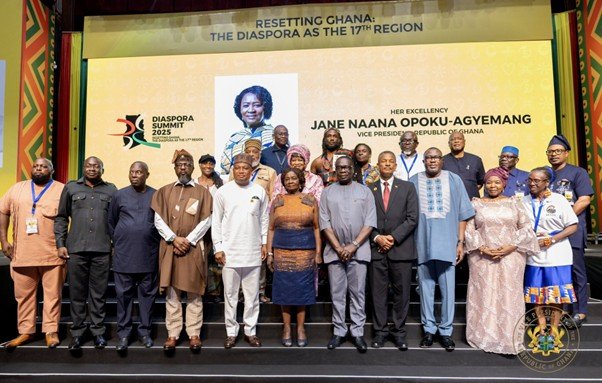
Gathered in Accra on 19 and 20 December 2025, African political leaders, diaspora figures and development stakeholders placed reparative justice and diaspora investment at the heart of the 2025 Diaspora Summit. Under the ambitious theme “Resetting Ghana: the diaspora as the 17th Region”, Ghana reaffirmed its determination to make its diaspora a strategic pillar of its future.

By Esther Bagourdo
Held under the patronage of the Ghanaian presidency, the Office of Diaspora Affairs and the Ministry of Foreign Affairs, the 2025 Diaspora Summit is part of a broader effort to reset relations between African states and their citizens living abroad. The objective is clear: to move beyond symbolic ties and build concrete partnerships around investment, skills transfer, innovation and sustainable development. This approach reflects a significant shift in African policies towards their diasporas, now viewed not only as cultural or emotional communities, but as full-fledged economic, political and diplomatic actors.
Today, the African diaspora represents a major economic lever. Remittance flows to the continent amount to tens of billions of dollars each year, in several countries providing a more stable source of foreign currency than foreign direct investment or official development assistance. For Ghana, these financial flows, combined with the expertise and international networks of its diaspora, constitute a potential that remains insufficiently structured. By symbolically recognising the diaspora as a “17th Region”, Accra aims to create a political framework capable of channeling these resources into key sectors such as infrastructure, industrialisation, technology, education and the energy transition.

Reparative justice: “A moral and historical necessity”
At the opening ceremony, Ghana’s Minister of Foreign Affairs, Samuel Okudzeto Ablakwa, issued a solemn call for global mobilisation in favour of reparative justice for Africans and people of African descent. He described this process as a “moral and historical necessity”, recalling that the transatlantic slave trade and colonisation have profoundly shaped contemporary inequalities, both on the continent and within diaspora communities. In his view, acknowledging these historical crimes is an essential step towards lasting reconciliation and fairer international cooperation.
In the same spirit, Steven Isaack, Chair of Namibia’s Committee on Genocide, Apologies and Reparations, urged African nations to speak with one voice. He stressed the need to coordinate African diplomatic initiatives in order to strengthen their influence within multilateral forums. For him, African and diasporic unity is a sine qua non for advancing claims for reparations, whether symbolic, institutional or economic.
An assertive diaspora diplomacy
Beyond speeches, the Summit forms part of Ghana’s proactive policy to strengthen long-term ties with its diaspora. The exemption of visa fees for all officially registered participants illustrates the authorities’ willingness to remove administrative barriers and encourage the circulation of talent, ideas and capital. This form of diaspora diplomacy reflects a growing awareness: in a global context marked by economic uncertainty and geopolitical realignments, diasporas represent a strategic asset for resilience and influence.
The participation of several African countries, including Senegal and Togo, underscored the pan-African dimension of the initiative. The presence of Faure Gnassingbé, President of the Togolese Council of Ministers, highlighted the growing interest of African states in diaspora engagement policies, which are increasingly seen as drivers of regional integration and South–South cooperation.

To close the opening ceremony, Ghanaian President John Dramani Mahama called for collective mobilisation between Africa and its diaspora around reparative justice and the reappropriation of African history. He emphasised the need to challenge narratives inherited from the colonial era and to reaffirm Africa’s contribution to world history.
Paying tribute to iconic pan-African figures such as Marcus Garvey and Kwame Nkrumah, he also announced his intention to bring a motion before the United Nations to seek official recognition of the transatlantic slave trade as a crime against humanity—an initiative aligned with a broader international movement for the recognition and redress of historical injustices.
Between memory, economy and the future
Through this summit, Ghana is advancing a vision in which historical memory, international justice and economic development are inseparable. By elevating the diaspora to the status of a “17th Region”, the country is laying the foundations for an innovative model that combines symbolic recognition with a development strategy. This choice reflects a pragmatic pan-Africanism, focused on mobilising Africa’s human, financial and cultural resources on a global scale—an approach that many countries on the continent are now watching closely as a possible way to turn the weight of history into a lever for the future.