


Davos 2026 : global dialogue in a fractured world
Davos 2026 served both as a mirror of a deeply unsettled world and as a test of whether global dialogue can still translate into meaningful cooperation. Analysis.

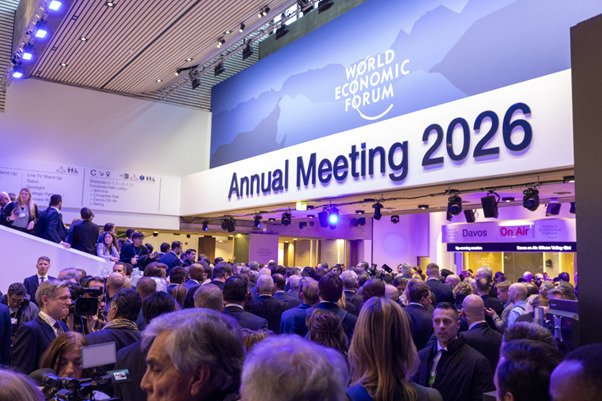
From 19 to 23 January 2026, the World Economic Forum (WEF) took place in Davos-Klosters, Switzerland, under the theme A Spirit of Dialogue. Bringing together nearly 3,000 global leaders, the forum unfolded against a backdrop of geopolitical fragmentation, persistent trade tensions, and accelerating climate and technological transitions.
From the opening sessions, leaders acknowledged that the international system has entered a phase of structural change. Canadian Prime Minister Mark Carney captured this shift, stating: “For decades, countries like Canada prospered under what we called the rules-based international order. That bargain no longer works.”
This assessment reflected a broader consensus that post-Cold War governance frameworks are struggling to keep pace with new power dynamics and economic realities.
Trade tensions were central to discussions. Chinese Vice-Premier He Lifeng reiterated a long-standing message at Davos: “Tariffs and trade wars have no winners.”
He emphasized the need to preserve economic globalization while reforming it to address its imbalances, at a time when protectionist measures and strategic competition continue to reshape global trade.
We are living through a profound global shift
On the European side, European Commission President Ursula von der Leyen reaffirmed the EU’s global ambitions, declaring: “Europe will always choose the world, and the world is ready to choose Europe.”
Her remarks highlighted Europe’s determination to remain a pillar of multilateral cooperation despite growing geopolitical uncertainty. French President Emmanuel Macron echoed this sentiment, noting that: “We are living through a profound global shift.”
Growth is real, but it should not lead us into complacency
Economically, discussions pointed to relative resilience. Several speakers referred to global growth of around 3.3% in 2026, a figure seen as encouraging but insufficient to address long-term structural challenges. As one participant warned: “Growth is real, but it should not lead us into complacency.”
Debt vulnerabilities, inequality, climate risks and energy access remain pressing concerns worldwide.
Interdependence was another recurring theme. A senior financial leader reminded participants that: “From an economic and business point of view, we depend on each other.”
This statement underscored the tension between rising nationalist policies and the reality of deeply interconnected global value chains.
Climate transition and technology were also high on the agenda. Artificial intelligence, energy security and clean-energy investment were widely seen as critical drivers of future competitiveness — but also as potential sources of inequality if governance frameworks fail to keep pace.
Africa at Davos: Stronger Presence, Limited Influence
Africa’s presence at Davos 2026 was more visible than in previous editions. Several leaders sought to reposition the continent as a source of global solutions. Democratic Republic of Congo President Félix Tshisekedi notably promoted his country as a “solution country” for the global energy transition, highlighting Africa’s strategic role in supplying critical resources for decarbonization.
Delegations from Nigeria and South Africa also emphasized ongoing economic reforms and the continent’s ambition to attract productive investment beyond traditional aid narratives.
However, while Africa succeeded in making its priorities heard, its influence remained limited. Core discussions at Davos continued to be dominated by major powers, trade rivalries and technological competition, often relegating African issues to specialized panels.
Dialogue remains essential but insufficient
Davos 2026 confirmed that the world has entered a period of deep transition, where dialogue remains essential but insufficient without concrete mechanisms for action. For Africa, the forum marked progress in visibility, yet also highlighted a key challenge: turning presence into sustained influence will require stronger coordination, clearer collective positions and a strategic role within global economic and political negotiations.