


Corruption : Africa makes progress… timidly
The latest Transparency International Corruption Perceptions Index (CPI), recently published, paints a mixed picture of the fight against corruption in Africa. Between countries making gains, worrying stagnation, and sharp declines, public governance remains a key determinant of citizen trust, economic development, and attractiveness to investors. Analysis.

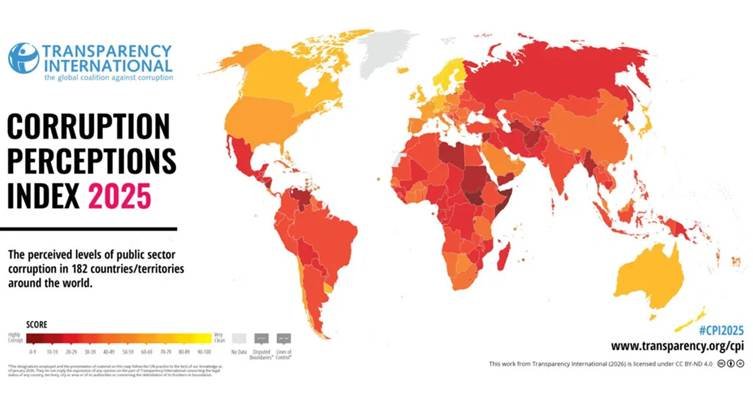
The Corruption Perceptions Index (CPI) from Transparency International ranks 182 countries and territories each year by perceived levels of public sector corruption on a scale from 0 to 100 — with 0 indicating high perceived corruption and 100 indicating very low perceived corruption. The 2025 report, released in February 2026, shows that Africa overall remains below the global average, yet some notable variations have emerged.
Seychelles at the Top
Across Africa, disparities are significant but several remarkable performances stand out. In sub‑Saharan regions analyzed, Seychelles emerges as the highest‑perceived African country with a score of 68/100, followed by Cape Verde (62), Botswana (58), and Rwanda (58), demonstrating that transparency and institutional accountability efforts can yield results. Conversely, several African countries are among the world’s lowest scores. According to the CPI 2025, Somalia and South Sudan sit at the bottom of the global rankings, each with 9/100, reflecting persistent structural challenges such as political instability, weak oversight mechanisms, and fragile judicial systems.
Corruption remains a major threat to stability, development and democracy
The report emphasizes that sub‑Saharan Africa has the lowest regional average, around 32/100, making it the most affected region by perceived corruption globally. This situation, according to Transparency International, stems from weak institutions, deficient oversight systems, and constraints on civic space, factors that undermine public accountability and transparency.
The impact of these corruption perception levels goes beyond rankings alone. Low CPI scores are consistently associated with reduced attractiveness for international investors, as transparency and the rule of law are considered essential in economic decision‑making. In a context where African countries seek more foreign direct investment to drive growth, these perceptions significantly dampen investor confidence. While the report does not provide a specific economic cost figure tied to corruption in Africa, it underscores that corruption “remains a serious threat to stability, development and democracy.”
More than two‑thirds of countries score below 50, indicating serious corruption problems in most parts of the planet
This phrase accurately reflects the original English used by Transparency International: “the vast majority of countries are failing to keep corruption under control: more than two‑thirds – 122 out of 182 – score under 50 in the index,” which clearly signals the widespread challenge of corruption across the world’s regions.
The CPI’s analysis further highlights the importance of protecting civic space, including freedoms of expression, opinion, and association. The report notes that degradation of these liberties is often linked to rising corruption perception, as it weakens the capacity of media and civil society to monitor abuse of power and hold leaders to account. Restrictions on media freedom, pressures on independent organizations, or weak judicial independence are all identified as factors that exacerbate perceived corruption levels.
Transparency International calls on leaders to strengthen judicial independence, political finance transparency, media freedom, and action against illicit financial flows — all measures deemed essential to reverse the trends observed in 2025.
Some initiatives offer reasons for cautious optimism. For example, Rwanda’s score of 58/100 reflects sustained efforts in transparency and accountability, including digitalization of public services and real‑time publication of public procurement data, which reduce opportunities for opaque practices. In Morocco, mechanisms for tracking asset declarations among senior officials have been introduced to reduce conflicts of interest. These examples illustrate that structural reforms and institutional innovations can play a positive role in improving governance.
Placing Transparency at the Heart of Africa’s Agenda
Furthermore, regional frameworks such as the African Union’s Continental Anti‑Corruption Strategy and the integration of anti‑corruption norms into regional agreements like the African Continental Free Trade Area (AfCFTA) are striving to place transparency at the center of Africa’s political agenda. Experts emphasize that sanctions, strengthened institutions, and increased regional cooperation are essential to translate these ambitions into measurable results.
That said, the CPI 2025 report warns against an overly pessimistic view and invites readers to see Africa not only as a region facing challenges, but also as a space where targeted reforms and a dynamic civil society can play a decisive role in sustainably reducing perceived corruption.
Consult the report : Corruption Perceptions Index (CPI)