

“Bàkku” at the Museum of Black Civilizations : towards a reaffirmed African architectural aesthetic
Until March 5, the Museum of Black Civilizations (MCN) in Dakar is hosting Bàkku, a multidisciplinary exhibition that explores the relationships between architecture, visual arts, and African critical thought, offering a renewed perspective on the continent’s imaginaries and cultural issues.

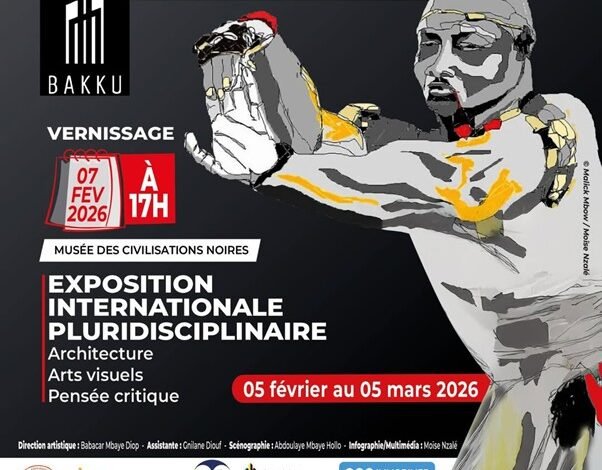
Since its opening, the Museum of Black Civilizations has established itself as a key platform for reflection and cultural production on Africa. Within this framework, the Bàkku exhibition seeks to engage viewers, knowledge, and practices around African critical and aesthetic thought applied to architecture and visual arts, going beyond simple disciplinary classifications to open new perspectives on urban and cultural forms across the continent.
An Intellectual and Aesthetic Movement
The concept of Bàkku — a term borrowed from Senegalese culture by the organizers — does not only designate a collection of exhibited works, but an intellectual and aesthetic movement. It aims to “reclaim an African architectural identity and break with urban chaos inherited from external models,” according to a recent analysis of the movement.
The exhibition brings together contributions from architects, artists, and thinkers from about twenty African countries, reflecting the diversity and richness of the continent’s cultural heritage while questioning its place in contemporary societies. Through photographs, models, sculptures, and visual works, Bàkku highlights emblematic examples such as the old mosque of Dioulassaba in Burkina Faso or alabaster sculptures that engage in dialogue between form, material, and memory.
Bàkku “is a call to return to African architecture that reflects us”
For the curators and movement participants, Bàkku is not only about aesthetics but also a critical thinking approach. At the opening, the artistic director, Babacar Mbaye Diop, emphasized that Bàkku “is a call to return to African architecture that reflects us,” underlining the importance of rethinking built spaces based on the social, climatic, and cultural realities specific to the continent.
The relevance of this debate takes place within a global context of rapid urbanization in Africa. According to demographic projections, more than one billion people will live in urban areas by 2050, posing immense challenges in planning, infrastructure, housing, and sustainability. In this sense, Bàkku explores not only how architecture can meet the material needs of African city dwellers but also how it can reflect their cultures, histories, and imaginaries.
Reinventing Paradigms of Creation and Urban Life
Several thematic axes structure the exhibition, including memory, identity, the genesis of architectural forms, and the connection between art and housing. This approach aims to show that architectural forms are not neutral but carry political, social, and symbolic meanings, inherited from the past while engaging with contemporary challenges.
This dialogue is embodied in the works and installations on display: some recall vernacular architecture, while others offer more experimental visions that question the future of African cities. The goal is to foster collective reflection that goes beyond mere aesthetics to reinvent paradigms of creation and urban living. The Bàkku exhibition also reaffirms the museum’s role as a space for living critical thought, aligned with its strategy of democratizing and opening access to knowledge, as evidenced by the increasing overall attendance at the MCN in recent years.