

The Gallery of the Five Continents : a silent revolution at the Louvre Museum
At the Louvre, a profound yet discreet transformation is redefining how the global history of art is told. With the opening of the Gallery of the Five Continents on 3 December 2025, the world’s largest art museum finally offers non-European arts a position of equality alongside Western masterpieces. This initiative — the result of an unprecedented collaboration between several French cultural institutions — invites enriched cultural dialogue and a more universal reflection on world heritage.

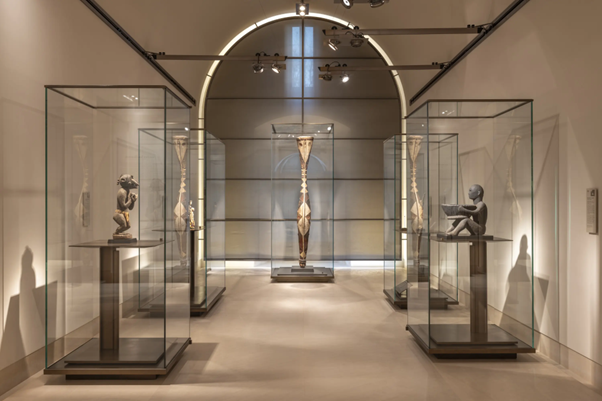
It is a small revolution in the museum world, subtle but significant. The Louvre Museum in Paris inaugurated the Gallery of the Five Continents in December 2025, a fully redesigned space showcasing 130 major works from Africa, Asia, the Americas, Europe, and Oceania.
Until now, non-European arts had been displayed in the Pavillon des Sessions, opened in 2000 — a pioneering step, yet perceived as marginal within the Louvre’s vast layout. With the creation of the new gallery, these works now fully enter the main museological narrative, alongside the paintings, sculptures, and objects that have made the institution world-famous.
To go beyond the classifications inherited from a Eurocentric view of art history and propose a more global reading of human cultures
Born from a partnership between the Louvre and the Musée du quai Branly–Jacques Chirac, this gallery does not merely exhibit isolated pieces. It offers a thematic journey that juxtaposes objects from very different cultural traditions, highlighting historical, aesthetic, or symbolic correspondences. The ambition is clear: to go beyond the classifications inherited from a Eurocentric view of art history and propose a more global reading of human cultures.
In the scenography designed by architect Jean‑Michel Wilmotte, the space is bright, open, and encourages connections between the works of distant civilizations. At the entrance, visitors are welcomed by a series of nine paintings by South African artist Marlene Dumas, specially created for the occasion, symbolizing the meeting of sensibilities and origins — a powerful way to underscore the universality of artistic creation.
Opening an Intellectual and Cultural Debate
Beyond the purely aesthetic aspect, this new space opens an intellectual and cultural debate on the provenance of artworks and the role of institutions in the restitution or conservation of world heritage. A series of meetings and conferences is scheduled through 2026 to deepen these questions, involving international specialists and directors of major museums.
The Gallery of the Five Continents therefore marks an important milestone in the Louvre’s evolution towards a more inclusive and universal museography, where the arts of the world are no longer relegated to the periphery but integrated at the heart of the discourse on art and humanity.