

Green revolution : African agriculture in the age of innovation
Under demographic pressure, growing climate urgency and persistent food insecurity, African agriculture is at a historic turning point. Long perceived as a subsistence sector, it is now emerging as a space for innovation, investment and economic transformation. Digital technologies, local agro-industry, inclusive financing and the rising role of rural women: this special feature, produced in partnership with Afrique Grenier du Monde (AGM), explores the ongoing transformations and the levers capable of making agriculture a sustainable pillar of African growth.

Africa holds nearly 60% of the world’s uncultivated arable land, according to the World Bank. Yet the continent still imports more than 75 billion dollars’ worth of food every year, revealing a structural paradox between agricultural potential and external dependence. As Africa’s population is expected to exceed 2.5 billion people by 2050, agriculture is no longer merely a production issue; it has become a strategic, social, economic and political priority.
Africa’s food market could reach 1,000 billion dollars by 2030, making agriculture and agribusiness among the most promising sectors on the continent
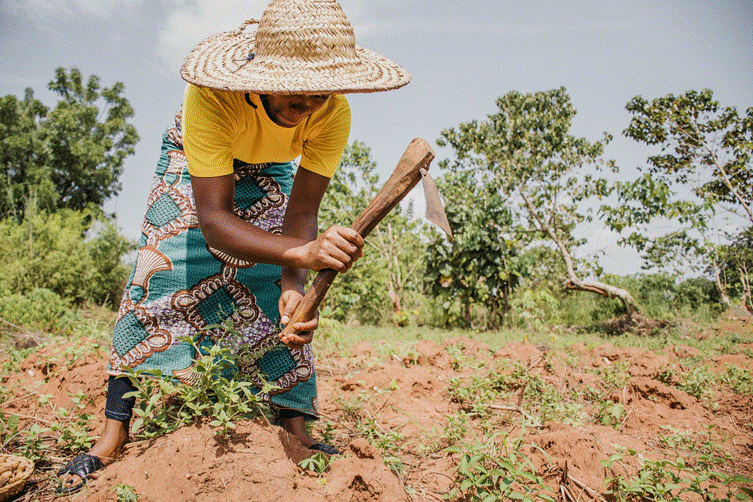
Agriculture remains at the heart of African economies. In sub-Saharan Africa, more than 60% of the working population derives its livelihood from the sector, primarily through family farming. Across the continent, nearly 80% of agricultural land is cultivated by smallholder farmers, who form the backbone of local food systems.
Yet despite this central role, Africa accounts for only around 10% of global agricultural production, while holding approximately a quarter of the world’s arable land. This gap highlights the urgency of structural transformation driven by investment, innovation and the upgrading of agricultural value chains.
Economic projections confirm the scale of the opportunity. According to the African Development Bank (AfDB), Africa’s food market could reach 1,000 billion dollars by 2030, up from around 280 billion today, positioning agriculture and agribusiness as among the continent’s most promising growth sectors.
Innovation: from the field to the smartphone
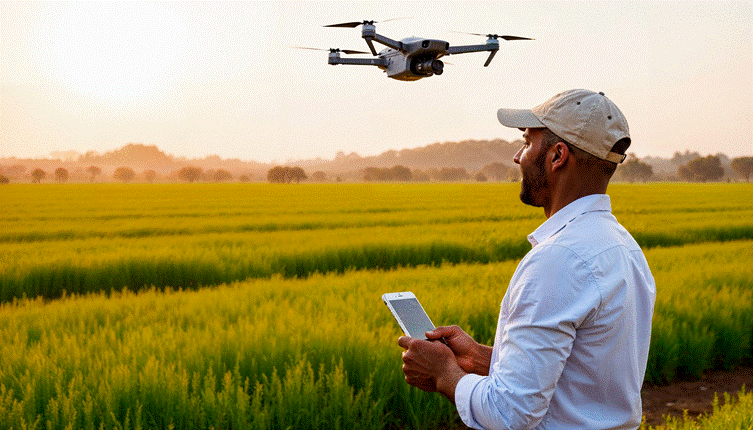
In recent years, African agriculture has entered the digital era. Climate forecasting tools, platforms connecting farmers to buyers, mobile payment solutions, crop traceability systems and digital access to inputs are reshaping the entire agricultural value chain.
The AfDB estimates that digitalization could increase agricultural productivity by 20 to 30%, by improving access to information, markets and financial services.
The FAO clearly states: “Agricultural innovation is essential to strengthen the resilience of food systems to economic and climate shocks.”
In a context marked by recurring droughts, floods and soil degradation, climate-smart agriculture, precision irrigation and improved seeds are becoming indispensable solutions.
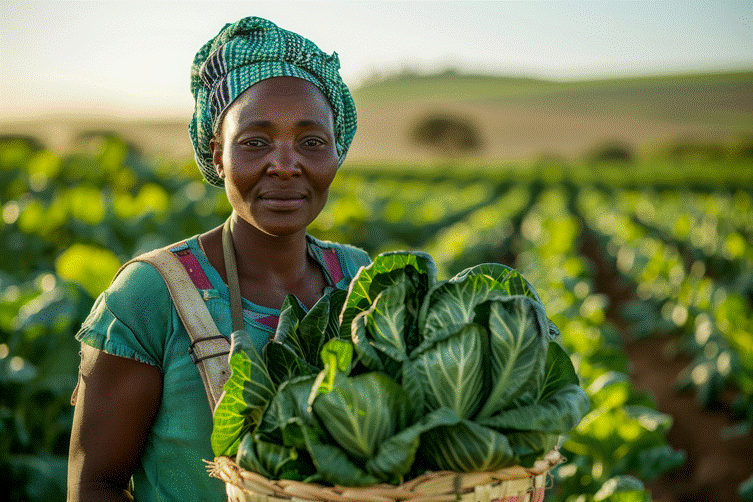
Another pillar of this green revolution is women. They represent around 50% of the agricultural workforce in Africa, and up to 70% in certain rural areas, according to the FAO. Yet they own less than 15% of agricultural land and remain largely excluded from access to credit, technologies and training.
The stakes are considerable. According to the FAO, closing the productivity gap between women and men could increase agricultural yields by 20 to 30% and lift up to 150 million people worldwide out of food insecurity. Investing in women is therefore not only a social imperative, but a rational economic choice.
“Africa’s future depends on its ability to feed its population while creating value locally.”
Africa’s agricultural revolution is not unfolding solely in the fields, but also through local processing. Today, a significant share of agricultural value added still escapes African producers due to the lack of structured agro-industrial capacity and adequate infrastructure.
The AfDB emphasizes that the development of local value chains could create millions of jobs, particularly for young people, while significantly reducing dependence on food imports.
“Africa’s future depends on its ability to feed its population while creating value locally,” the pan-African institution regularly stresses.
Accelerating transformation to become a true engine of resilience, food sovereignty and economic prosperity
Despite progress, challenges remain substantial. The FAO estimates that 30 to 40% of Africa’s agricultural production is lost after harvest, weakening farmers’ incomes and market supply. These losses are compounded by the growing impacts of climate change, which continue to undermine already fragile systems.
African agriculture therefore stands at a decisive crossroads. Between immense potential and persistent constraints, it must accelerate its transformation to become a genuine engine of resilience, food sovereignty and economic prosperity.
Related reading : https://africa-news-agency.com/agm-women-network-when-female-capital-redefines-agricultural-investment-in-africa/