


West Africa : towards regional gas security
Meeting in Abidjan on December 7, 2025, the Ministers of Energy of Togo, Benin, and Côte d’Ivoire announced the creation of a tripartite framework to secure natural gas supply in West Africa. This initiative, supported by the World Bank, aims to reduce costs, diversify sources, and strengthen regional energy stability. Analysis.

Faced with growing energy demand, Togo, Benin, and Côte d’Ivoire have decided to strengthen their gas cooperation. On December 7, 2025, in Abidjan, the Ministers of Energy of these three countries validated the establishment of a tripartite framework to secure the supply of natural gas, a key resource for electricity generation and industrial development. The meeting benefited from the technical and financial support of the World Bank, which said it is ready to support the project through the IFC and MIGA.
A real energy deficit hindering growth
Several West African countries face a significant natural gas supply deficit, which strongly constrains their electricity capacities. In Togo, for example, daily natural gas demand is estimated at around 35,000 MMBTU per day, but supplies cover only 5,000 to 15,000 MMBTU, and sometimes none, according to recent Togolese government data. This shortfall drives up electricity production costs and frequent outages, forcing governments to rely on expensive liquid fuels to compensate for the lack of gas.
At the continental level, natural gas demand is expected to continue growing strongly in the coming years: according to the Gas Exporting Countries Forum (GECF), it could increase by an average of 3% per year until 2050, rising from 170 billion m³ in 2023 to 385 billion m³ in 2050. This natural fuel, less polluting than other fossil fuels, will supply a growing share of the continent’s energy mix, particularly for electricity production and industrialization.
Cooperation to pool and secure supply
Togo, under increasing pressure on its energy supply, suffers from high production costs linked to the use of liquid fuels. Minister Robert Koffi Eklo emphasized the need for regional coordination and mentioned the eventual creation of a regional gas institution modeled on the WAPP (West African Power Pool) for electricity. “Just because one country advances does not mean the other falls behind. We are open to strong regional energy cooperation to meet the needs of our populations,” said Minister Robert Koffi Eklo.
This approach should allow for pooling gas purchases, strengthening demand credibility, and improving negotiation conditions with international suppliers.
Objective: reduce costs for governments and consumers while consolidating energy security and promoting the transition to cleaner sources
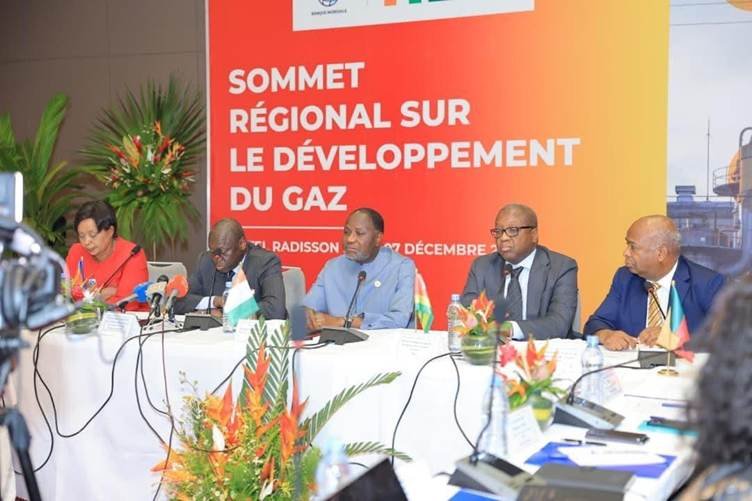
The final declaration adopted by the three countries outlines three priority measures: the pooling of liquefied natural gas (LNG) imports, the creation of a technical working group within a month to study the operational model, and the structuring of a bankable project with World Bank support. The goal is twofold: reduce costs for states and consumers while consolidating energy security and promoting the transition to cleaner sources.
Côte d’Ivoire, an emerging gas hub
Côte d’Ivoire positions itself as a strategic asset in this regional dynamic. The country has significant gas resources, notably the Baleine field, which contains about 3.3 trillion cubic feet of gas and has been supplying several national power plants since 2023. The current exploration phase, conducted with the Deepwater Skyros vessel, plans to drill three new wells in the Civette, Calao, and Caracal areas, further strengthening the national gas potential.
At the same time, a bidirectional pipeline project connecting Côte d’Ivoire to Ghana is under study. This project, which could supply electricity production, fertilizer industries, and other industrial sectors, aligns with regional energy integration logic: it could complement the West African Gas Pipeline (WAGP), currently the main gas corridor connecting Nigeria to Ghana, Togo, and Benin, whose capacity is often limited by irregular supplies from Nigeria.
The creation of a second gas hub in West Africa could reduce structural dependence on Nigerian gas and diversify sources for Togo and Benin, thereby improving the sub-region’s energy resilience.
A model for other integrated initiatives in energy, water, or infrastructure in the region
At a time when the sub-region seeks to close an energy deficit that costs up to 4% of its annual GDP, according to the World Bank and ECOWAS, every step toward greater gas security helps improve population access to essential services and strengthens economic growth.
The analysis of the issues shows that this tripartite cooperation could have a major impact on energy stability and industrial competitiveness. Securing natural gas would reduce electricity production cost volatility, support the development of energy-intensive industries, and advance the transition to cleaner sources.
Regionally, this tripartite framework could also serve as a model for other integrated initiatives in energy, water, or infrastructure, strengthening West Africa’s strategic autonomy.