


Africa Could Double Its GDP by 2040 — If Infrastructure Investment Reaches USD 155 Billion a Year
A new joint report from the OECD and the African Union Commission argues that Africa’s economic transformation hinges on one priority: scaling up infrastructure investment. But public debt, shrinking development aid and limited private capital threaten this ambition.

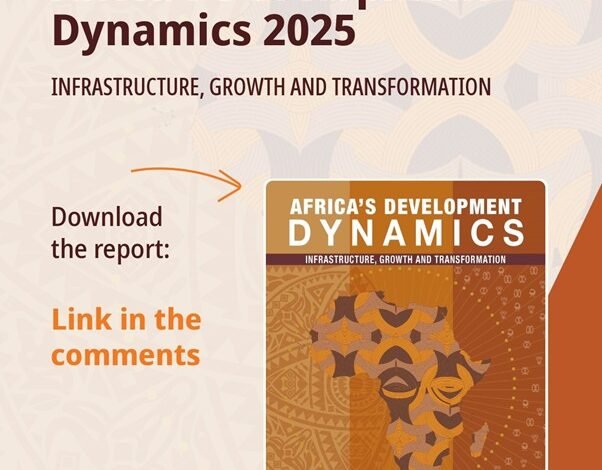
The 2025 edition of Africa’s Development Dynamics presents a decisive message: Africa’s growth potential is substantial, yet hindered by a persistent infrastructure gap. Between 2016 and 2020, the continent invested only USD 83 billion per year — barely 3 % of its GDP. According to the report, increasing this figure to USD 155 billion annually, equivalent to 5.6 % of Africa’s 2024 GDP, would raise growth by 4.5 percentage points per year and allow the continent to more than double its GDP by 2040.
The Comoros, Lesotho, and Tanzania show the way
Several countries — including Comoros, Lesotho, Tanzania and Zambia — already invest over 5 % of their GDP in infrastructure, reaching levels comparable to China or Viet Nam. These examples show that sustained investment is possible, though far from widespread.
African governments finance 41 % of all infrastructure spending, giving them a pivotal role. However, fiscal constraints continue to tighten: between 2019 and 2023, they spent seven times more on debt servicing than on infrastructure, significantly limiting their investment capacities.
A trend that is becoming clearer: the decline in official development assistance
Development partners — bilateral and multilateral — contribute 48 % of Africa’s infrastructure financing. While development finance has increased since 2010, recent trends are alarming: official development assistance fell by 9 % in 2024 and is expected to drop by up to 17 % in 2025. Low-income countries in sub-Saharan Africa are likely to be the most affected, with projected declines ranging from 16 % to 28 %.
Private capital remains under-mobilized, accounting for just 11 % of infrastructure investment — a modest share given potential returns of up to 20 %, among the highest globally. Regulatory gaps, insufficient data and perceived risks continue to deter investors.
Redirecting investments toward infrastructure with high economic value
The report calls for targeting high-return infrastructure sectors, such as roads, railways, fibre-optic networks and solar energy, all crucial for regional integration and global value chain participation. Strengthening governance, improving maintenance, expanding public-private partnerships and deploying quality certifications are also essential to build investor confidence.
Integrating environmental and social risk management into planning is another priority to ensure sustainable growth and long-term investment stability.
Ultimately, Africa stands at a turning point. The potential to reshape its economic future is real — but achieving it requires a major shift in financing strategies and a stronger, more coordinated commitment from governments, development partners and private investors.
Read the report : Africa’s Development Dynamics